It's personal project season — a great time of year at Prairie Creek when kids regularly come bounding up to you, eager to share the latest fact they've learned about their passion. The lunchtime conversations one overhears are full of tidbits from research: "Oh, you probably had that dream during REM sleep…" "Did you know that sonar didn't find the wreck of the Titanic?" "Aliens didn't make stonehenge…"
While fifth graders do the work for their honors project at home, they support the work of the fourth graders as "mini-mentors." Both fifth and fourth graders attend the mini-lessons that review the research process. For the fourth graders, it is the first time they are asked to be so independent in their work. They are taking formal notes for the first time, siting resources, and organizing their information to write. This year I've noticed how powerful it is to have the fifth graders involved in the lessons. They are asking nuanced, specific questions about the skills we're presenting, questions that the fourth graders do not yet have enough experience to formulate. What serves as an introduction for the fourth graders is an opportunity for the fifth graders to hone their understanding.
The fourth grade project completely mirrors the Honors Project process from the way students choose topics and formulate questions to the formats in which they are asked to teach about their topics. Very, very little of the fourth grade project is done at home so that students really get a sense of what they can do by themselves. Of course we offer a lot of guidance and support but always with an eye toward making sure that the fourth grader has ownership of the process and the product.
So far we've had mini-lessons on picking good topics, developing good questions to guide one's research, categorizing questions, finding resources, using the Internet to find information, citing resources, taking notes, paragraphing, topic sentences and support, great titles, and interesting leads. Rachel has taught the lessons about paragraphs and support and the kids are hungry for more focus on this nascent skill. An understanding of one's reader can really begin to develop in 4th and 5th grade — students begin to conceive of an audience beyond themselves. (And therefore, the need to make themselves comprehensible and interesting to someone else.)
Future lessons will include organizing one's notes, writing paragraphs from notes, sharing information visually, writing captions, great leads, involving one's audience, writing notes for a presentation, answering audience questions and clear presentation skills. You can find a lot more detail about the specifics of the process in our Honors Project Resources. But, if you're a fourth grade parent remember that these are the expectations for the Honors Project, your child's presentation and research will follow the same format but be about a third of the size.
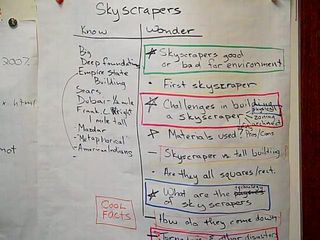 Research begins with a "know" and "wonder" chart. Students decide if the answer to a question can be answered in a sentence (dot), a paragraph (dash) or several resources (star). Fourth graders are encouraged to have at 2-3 dash questions and 2 star questions. Questions are then grouped by topic and color coded. Information pertaining to a question is put on a matching colored index card.


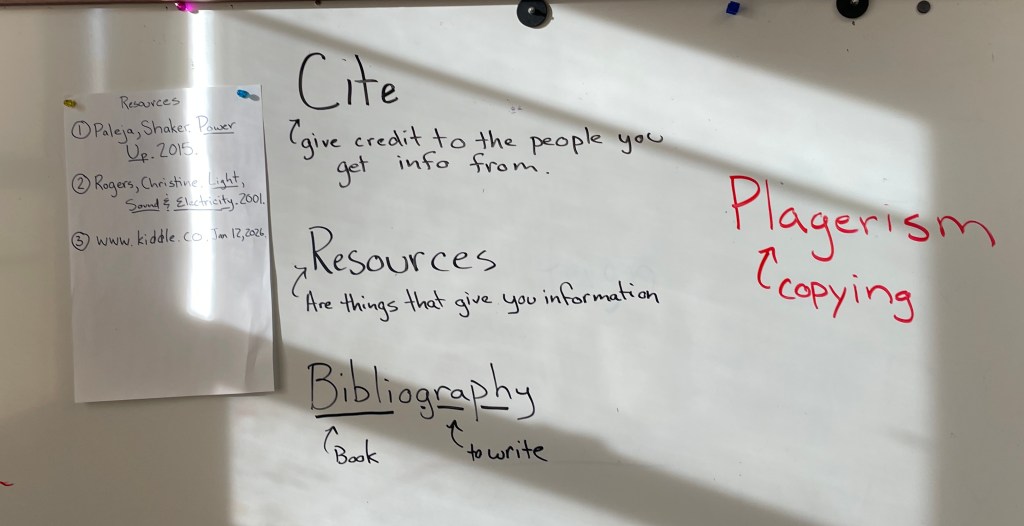
Every resource is assigned a number on a resources page in the Blue Book. This is used by children (and teachers) to confirm facts and get more information if needed. Students learn very quickly how nice it is to have web page addresses written down.
Each note card has the source number and page number in the upper corner. This helps children find additional information later and prepares them for more advanced citation. (We do not require any citation in their text, just a resources page)

Color coded index cards make it easier to sort information into paragraphs. Each color corresponds to a key question or area of research.
Students are encouraged to read a paragraph, close the book, and take quick notes on a card. Bullet points and "note language" are stressed.


 The Rookery
Leave a comment