It's Electric (If I knew how to insert the music to the " Electricslide" here, I would)
Hopefully by now you've heard about some of the initial adventures of our first theme. Yesterday, students were very sure they could easily make light with a battery, a paperclip and a flashlight bulb. Forty-five minutes later, they had done it. This is one of my favorite lessons because even adults who can give you a dictionary definition of a circuit can sometimes have difficulty with the task. It's another illustration of how "knowing" something is very different from "doing" something. Today, we looked at insulators and conductors (including our tongues!) No, I don't have any video.
Some of the fifth graders were initially wondering if they would be learning new things during the theme — electricity was the focus of two days of our 4th grade week last year. Today they began to get the answer to their question as we really started to explore the role of negative ions, acids and electron transfer. It builds directly on the work they did with Rachel and me in our chemical engineering lessons. When we stuck our electrodes into salt water today to see if it was a conductor we found that yes, it was and, more importantly, the electrodes had started to fizz and there was black dust swirling off of the metal ends. The kids don't know it yet, but we were breaking water into Hydrogen (at the negative pole) and Oxygen (at the positive). It was an unexpected result and I was thrilled when I saw Dani Chihade (a chemist at Carleton) picking up her children at extended day so that I could quiz her about what we had seen. Dani has kindly offered to come in and talk to us during her spring break.
Tomorrow – switches. Soon – parallel circuits, turning photons to electricity, amplifiers and receivers, electromagnetism, motors, battery making. DOES ANYONE HAVE A LEYDEN JAR?
pH Power
I've been meaning to share a little bit about our final chemical engineering class. We talked about pH in connection with the ionization we saw when we Built an Atom. We used pH paper to measure the pH of various household items and then the young engineers were asked to neutralize vinegar. Working 1/4 of a teaspoon of baking soda at a time, they soon noticed that the bubbling wasn't as furious when they stirred the baking soda into the vinegar. About 2 teaspoons is enough to neutralize a half a cup of vinegar.
It was interesting to me that even after observing that the bubbling had died down and that the solution was neutral, like water, students were still asking "Can we dump a whole lot of baking soda in at one time!!!!" It's an illustration of how hard it is to shift students' conceptual understanding. After trying it out, students agreed that it would have been more exciting to dump a lot of baking soda into fresh vinegar (and a lot more of it.) By the way, a jug of vinegar and a box of baking soda make one of the best (and cheapest) birthday presents for a ten year old ever.
Getting Organized
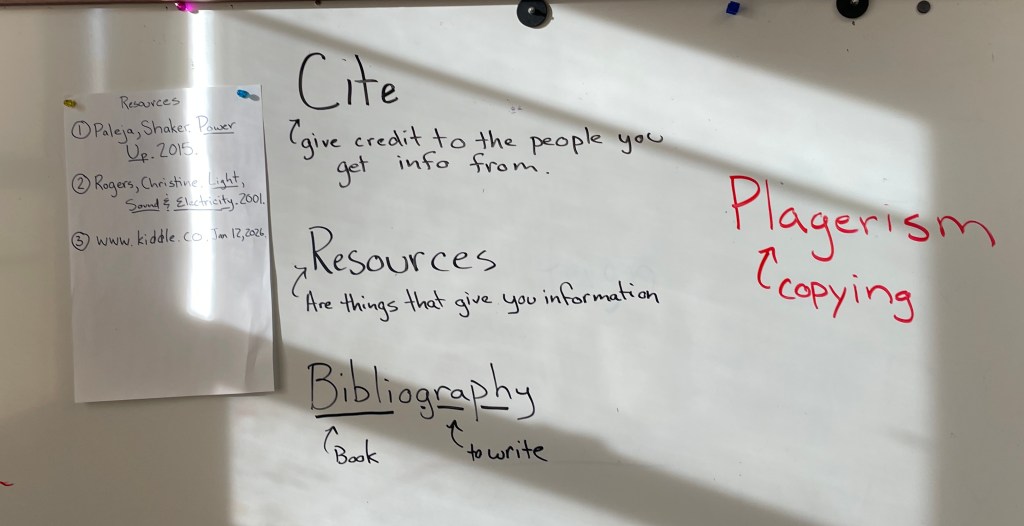
Over the next few days we'll be doing mini-lessons on how to get organized to write. For many 4th grade students, this is a new step in the writing process. In the past, its been enough to just write down everything they'd learned without thinking much about structure.
We'll look at how to sort note cards to look for gaps in our research, creative non-fiction options, how to re-sort notecards into sub topics that make sense to write about, how to order notecards within those sub topics, how to create an informal outline to write from and how to go from notecard to paragraph. That last one is surprisingly difficult and I often have students read through the notecards, "tell the story" of that information to a friend without looking at the cards, and then write down that story only looking at the cards for dates or spellings.
I've loved having the fifth graders in our lessons. They ask wonderful questions and their intense interest in the lessons has helped the fourth graders see that this is information they will really be using.


 The Rookery
Leave a comment