 In the week before spring break, we were very busy — motors, Morse code, static electricity, lightning, capacitors, and electrolysis were all on the docket.
We'd spent so much time on current electricity that Rachel and I were excited to explore static charge with the students. Rachel's mini-lesson on lightning was a huge hit (did you know that lightning hits the earth 100 times a second?) and everyone enjoyed storing static charge in a Leyden jar. It allows you to collect charge and then discharge it all at once with a big "zap." (Well, it would have been a big zap if we hadn't been working on one of the most humid days we've had this spring.)
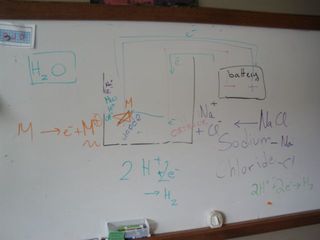
On Wednesday, Dani Cohen, a physical chemistry professor at Carleton, came in to talk to the class about electrolysis. It's a phenomenon the class noticed when we were testing different fluids to see if they were conductors. When we made an open circuit and put both clips into some salt water, the clips seemed to fizz, the water started to turn orange and the clips turned black. What was going on?
As Dani explained to us, we were breaking apart water into hydrogen and oxygen! It was so exciting to watch the class pepper her with questions and take copious notes as she filled the board with chemical equations. After she left, I asked the Herons to take a look at the board (see above). "Look at that! If someone walked in here, they would think it was a high school chemistry class! How many of you were able to follow what was going on? How many of you were able to hang on?" Almost all of the hands went up enthusiastically and one child said confidently, "I was able to hang on with TWO hands!"
Now, the Minnesota fourth grade "standard" for electricity is that students understand an open and closed circuit. We would have missed out on so much learning had Rachel and I stopped the students at that point. Instead, by following their lead and delving deeper and deeper, they got to see a glimpse at the underlying structure of science. Suddenly, the learning we'd done in chemistry showed up again in electricity and the observational skills we used in our nature journals, were applied in a completely new way as we carefully noted the electrolysis reaction. I guess, "Children will begin to understand the underlying structure of the universe" might not be a terribly easy thing to assess on the MCAs.
Here's a video hodge podge of our recent work. In the first scene E.K. is getting a Leyden jar shock to her nose!


 The Rookery
Leave a comment