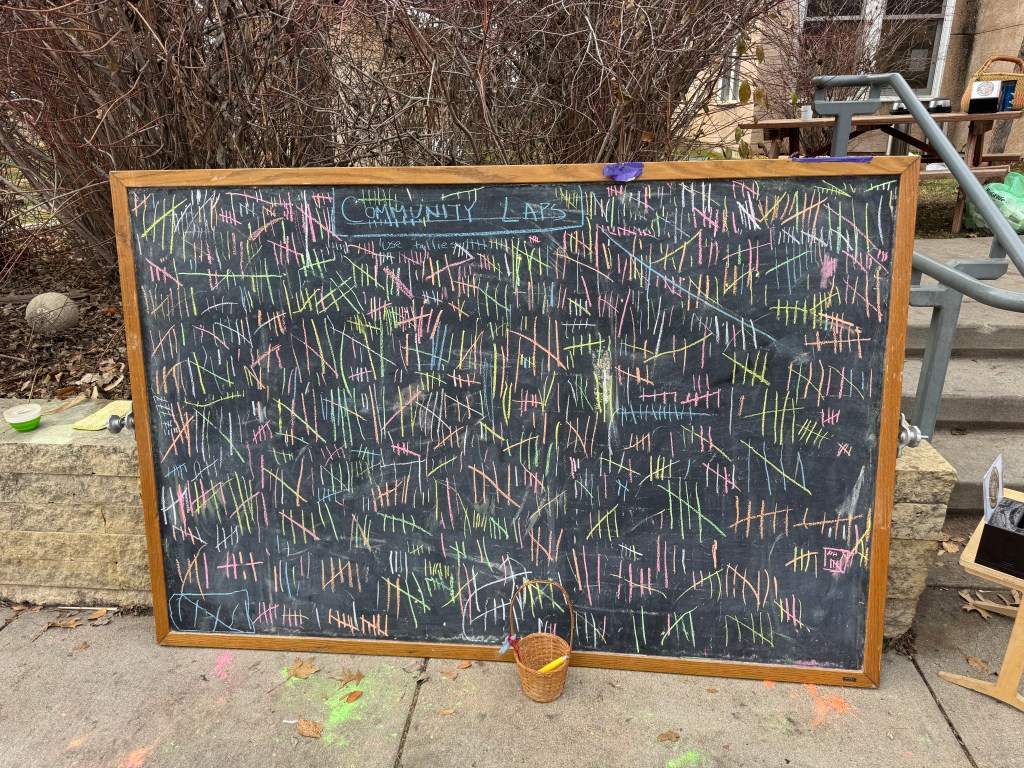
 The second and third graders are going to be collecting pennies to see how much 10,000 is. They're working on place value and as the pennies come in, they'll bundle them in powers of 10 until they get to 10,000.
It provided an authentic question for us to tackle in our rates unit. Just exactly how tall would a stack of 10,000 pennies be? We talked about the puzzle very briefly together and then students went off to tables stocked with pennies (but not 10,000!) and rulers.
An aside: I've been thinking some about the power of the word math "puzzle" in place of math "problem." This penny situation wasn't a problem at all, it was a curiosity, a wondering. And you go about tackling a puzzle differently than a problem. Failure isn't defined the same way, either. Your first attempt at a puzzle is rarely right, but you've gained more information. A problem, on the other hand, you want to solve as quickly and painlessly as possible. There is not joy in the solving process. Hmmm…it's just semantics, but still.
 Back to the pennies. After working for 15 minutes, many students had a good approach nailed down and most were very close to a solution. There was a heated argument about whether 18 or 20 pennies fit in a half inch. Another group was trying very hard to get a stack of 100 to stand up straight. One table was discussing whether it made a difference if you measure in centimeters or inches. No matter their measurement strategy, students converged on the idea of measuring a small set and extrapolating that relationship to get to the larger number. That's at the core of the concept of rates and ratio.
As you can see, students could approach this problem in many different ways and with many levels of sophistication. Some were ready to see that a larger sample size enabled you to reduce error in the final result. Others saw that finding an easy number to work with – centimeters provide more exact measurement than inches, would reap benefits. Many labeled their numbers as they worked, others tried to keep so much in their heads that they got confused as they moved forward in the problem.
 We came back together for a "math conference" in which students described their approaches and debated whether or not certain ideas would work to find the final answer. This is my chance to guide discussion and help students deepen their understanding of the concept as well as gain contact with those more sophisticated ideas such as the sample size's impact on error. One student put it beautifully — you may be off by a little but that "little" really adds up a lot of times!"
And the final answer? Forty one feet, eight inches (another great discussion about what 41.6 means when you're talking about feet). That's a lot of pennies. Now, Nancy's asked me if I think all of the pennies will fit into a gallon zip-lock bag. That might be a fun one to tackle with your Big Bird this weekend.



 The Rookery
Leave a comment