The Big Birds are working with geometry right now and seem to really be enjoying the concrete nature of the subject. We've named, measured, and drawn angles. We've looked at parallel and perpendicularlines. We've differentiated rays, lines, and line segments. Now we're tackling shapes.
Naming shapes is something we begin working on with children when they are pre-schoolers but in fourth and fifth grade we move from having a single way to identify a shape — square — to the multiple ways a shape can be identified — polygon, quadrilateral, parallelogram, rectangle, rhombus, square. The analogy of a kid who is a member of a family and a citizen of a town, state, country, continent and finally a representative of a species works for a lot of kids to help them understand how a shape can be all of these things at once. But it's a tricky thing and it can be easy to get muddled.
To expand our concept of how to categorize polygons, we are using a lot of logic tools such as inductive reasoning, Venn diagrams, and dichotomous keys. For example, I put up a shape that was not a polygon and one that was and students began to articulate the traits that all polygons must have by looking at multiple examples. We tried to construct a picture of how the square fit into the larger polygon scheme (which turned out to be a complex Venn diagram. Below is a part of it (it was set into a large parallelogram circle, inside a quadrilateral circle, inside a polygon circle):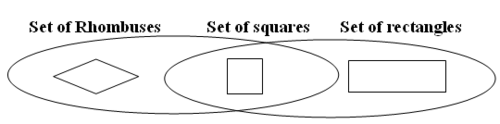
The students really enjoyed our dichotomous key work — it's like a choose your own adventure for shapes. You follow a simple progression of questions that leads you to finding the most specific name for a shape (and all of the names in between.) The more you use the key, the easier it becomes because you become more able to perceive differences among shapes and you become more familiar with the key questions for shape identification. You can try out our version here: Download Geometric_Dichotomous_Key We'll be working with dichotomous keys in our problem of the week — making one is even more fun than using one.
Have you been hankering for your own problem of the week? Here's your chance. When I was making up the shape dichotomous key, I couldn't figure out a way to break down rhombus, rectangle and square so that one could use the questions to identify that a square was both a rhombus and rectangle. Can you figure out a way to do it? I'd be thrilled ot hear your ideas. (You might try working on it along side your Heron — it is wonderful for them to see you puzzling something out.)


 The Rookery
Leave a comment