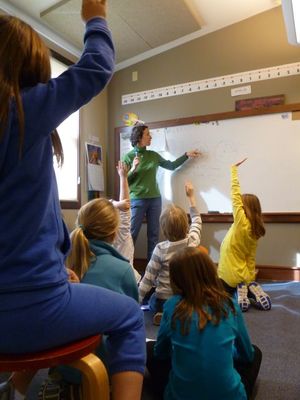
Today, the Herons were late getting back from math with Cathy. They burst out of her classroom in the midst of a heated debate. I caught snippets as the children filed back into the room, "It has to be the first spinner!" "No, it said 'OR'" Cathy followed, a broad smile on her face, "Sorry, Michelle, we ran out of time. We were in the middle of a debate about two different spinners and they were really passionate…"
These are the moments I am so glad that I work at a progressive school where our schedule is able to be flexible enough to meet the students' needs. There was no question about what we had to do next. I invited Cathy in, gathered the Herons in the meeting area, and then sat back to listen to what all the hubbub was about.
They were arguing about the meaning of "or" in the statement "There is a 75% chance that V,W. or X will win on the spinner." Two students had proposed two different spinners that illustrated this statement and the Herons were debating which one actually did. About a third of the class thought that the first spinner represented the statement because you would "win" if any of the three were spun. The others thought that one of the options had to have 75% all by itself in order to make it true and the other options didn't matter because of the "or." The spinners are below.
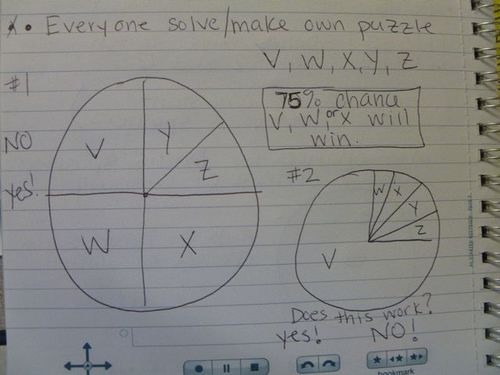
So, why didn't Cathy just correct the group that thought it was spinner #2? They wouldn't have believed her. We know that true understanding is only achieved when we identify incorrect concepts and help a child de-construct that idea and re-construct a new understanding. As children reasoned aloud, Cathy listened carefully to what they were saying. She (or a child she called upon) would then offer an idea that would challenge the misconception. The debaters would consider the new information and then offer their counter arguments. The cycle continues.
The act of debating clarifies ideas in students' heads. Because we model this kind of learning often, students are adept at listening to counter arguments and, when necessary, feel safe enough to change their minds.
But changing minds takes time. A lot of time. The conversation was still going strong after 20 minutes of additional time and started right back up when I asked a question about it as the kids came back from recess. They were still re-constructing their understanding.
I worry that in an effort to cover it "all," (meaning everything that may be on "the test"), we stop giving the kids time to talk. We stop taking the time to listen. And, as a result, we stop teaching, really teaching, so that the students learn.



 The Rookery
Leave a comment