Not sure of what half of the students will be interested in, I try to begin the school year with a theme that can go in a lot of different directions. This year, I chose "adaptation" and was prepared to explore biology, human technology, or social curriculum (how do we adapt when we join new groups).
From the first short lesson, it became clear biology is a passion for the Herons. We began the theme with a brief introduction to Mendelian genetics – identifying dominant and recessive genes and talking about how those genes are passed on to offspring. We learned about genetic mutation and how some mutations change an organism in a way that make it better able to survive (and reproduce more). These changes are called adaptations. Weighty stuff, to be sure, but within the familiar context of animals, the students were quickly able to understand how a species can change over time to become more and more successful in its environment.
An amazing book, Exploding Ants, and a segment from the BBC's Blue Planet series ignited the Heron's interest further. In fact, while we watched the video segment, the Herons were scribbling notes in their Blue Books and exclaiming, "Well, I know what I'm doing for my personal project!" The value of diversity is clear became clear as students realized that the more specialized an animal becomes through adaptation, the more able it is to exploit niches in the environment. We even learned about an animal who emits red light in order to illuminate the many deep sea creatures who have red pigment that is invisible to most other deep sea creatures (who illuminate with bluish light). Crazy stuff.
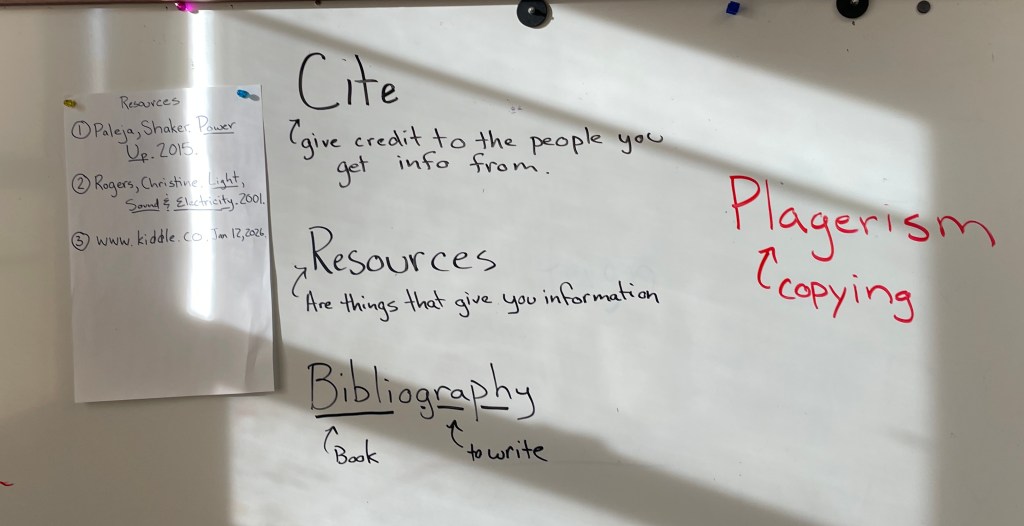
But some of the animals we're most familiar with are packed with adaptations, a fact that became clear as we researched a wide array of animals using internet resources. (This was our first foray into research and students quickly learned how to steer away from sites with suspect information like wikianswers.) They also learned to append their search strings with phrases like "for kids" in order to get resources more tailored for their needs.
Now we are preparing to teach other students (and you!) about adaptations. We came up with around 20 ways to share our learning — everything from an animal adaptation fashion show to a nature video narrated by a smarmy host who makes fun of the animals' adaptations and then regrets it. We're still working to incorporate some of the ideas into the final version of the event but the current plan is to create a zoo or series of habitats for our visitors to walk through with a tour guide. Students have chosen animals and are working to write paragraphs about the animal's adaptations. These will be incorporated into the tour guide's script. Students are busy creating costumes and sets for the zoo, too.
I'm always amazed how students step up during our theme work. Today a fifth grader who had gotten done with the basics of her set realized we should organize the different animals into habitats and created a list of each animal to be presented and the environment we'd need. Another fourth grade is working to create a welcome sign but realized we'd need to have a name for the event (he's put up a list for possible suggestions.) Others are experts at finding materials in the school. Still others are networking to get all of the different stuffed animals we need for our displays. As we get closer to the event, students will create more and more "sparkle" (which is what we call all of the "extras" that go beyond the basic teaching expectations.)
I allow the assignment to develop through the students' conversation and decisions. As their vision comes into focus, I help them define smaller interim goals that need to be accomplished to make their final concept work.
Whew. Thank you for sticking with this long blog post. I should have posted earlier about our work. Even with this long post, I feel I've under-reported much of what we've done. I hope you'll be able to come to our event to learn more.


 The Rookery
Leave a comment