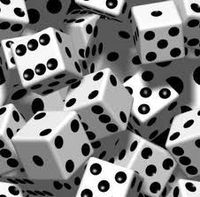
 One of my favorite math subjects to teach is probability (the Herons groan when I say that…whatever we're doing in math I tend to declare my favorite.) Probability is especially fun with fourth and fifth graders because they are intellectually able to comprehend mathematical probability but developmentally they are not quite ready to give up concepts of luck. So you can have a child who will tell you the chances of rolling a three are 1 out of 6 and then, in the next breath declare that she almost always rolls sixes. They know that every flip of a coin is a fresh start and that the coin doesn't know what has happened before. But they'll still almost always feel strongly that after three heads in a row, it's very, very unlikely to get another head!
Cathy, Amy and I are team teaching this theme with each of us working with a different prop. Amy is using spinners, Cathy is using dice, and I am working with cards. Students are rotating through our classes. One of our goals is to help students discover that the basic ideas in probability don't change, no matter what you're working with. The central concepts we are teaching in all three classes are:
- probability is the likelihood of an event happening
- experimental probability is using data from repeating an experiment such as a dice roll multiple times and using the previous results to predict future results.
- the more times one repeats an experiment, the closer the average results get to the mathematical probability.
- some experimental probability, such as weather forecasting, can only be done by collecting data about the past. There is no way to determine mathematical probability
- mathematical probability is using math to determine the likelihood of something happening
- Often, mathematical probability is determined by using the total number of possible outcomes as one's denominator in a fraction and the outcomes that "count" as the numerator. In this way, the likelihood of rolling an even number on a six sided die becomes three (the number of even numbers) out of six (the total number of outcomes). We teach the students to read the fraction bar as "out of" when we are working with probability.
We will have kids use what they've learned to design a simple carnival game that depends entirely on chance. They will figure out he likelihood of winning their games and they will have to determine how many winners they expect when the rest of the school comes to play their games.
Many students have been interested in thinking about how the games at Valley Fair or Defeat of Jesse James work. Thinking about how unlikely it must be to win if the game pays out a giant gorilla is a new thing for them. One group's first estimate was that 1 in 20 might win a game like that. As we talked about the price of a ticket, the price of a gorilla, and the carnival's desire to make a large profit, they realized that the chances of winning a gorilla were very slim indeed.
Probability is a part of our lives every day and an excellent chance to connect math to your home life.
- Play some board games and talk about the role of chance
- Play some simple card games (War or High/Low) and work out the probability. Games like poker are fascinating, too, but figuring out multi-event probability is still a stretch. Some but not all children have been playing with the idea — and we haven't even gotten into what happens when you have multiple chances.
- Talk about the lottery. Maybe even buy a lottery card to see what the chances of winning were.
- Figure out the likelihood of winning the lottery. The Minnesota Lottery even has a page to help you do this!
- Create some simple dice games and work out the probability involved.
- Talk about the weather and other types of experimental probability
Our new theme (blog post coming by Friday) has a very large probability component. We'll be traveling the Silk Road and rolling dice to determine the fate of the caravan as we cross deserts and face bandits. Yesterday, the students wanted to know what percentage of ships on the Medeteranian were lost to storms in 800 CE. Oh, my — here we go.


 The Rookery
Leave a comment