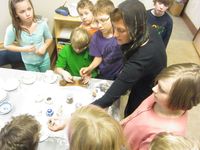
The caravan is on its way. We stopped last week in Constantinople where we learned some Greek, tried our hand at making felt, visited the Hagia Sophia, listened to the duduk, learned about bird liming and Greek fire, did some trading for entry tokens for the hippodrome, and ate some spoggia with garum (scrambled eggs with fermented fish sauce). Students also unearthed information about where the caravan might want to head next, discovered the secret of silk production did not lie in Constantinople, and traded some rumors about the road ahead and behind.
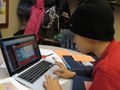
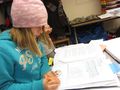
Whew. Students are mixing free exploration with responsibilities connected to their foci. All students must create a postcard with an image from the city we're in and a paragraph of detailed information about what they've learned. They also share information from their specialty by contributing to a visual dictionary and completing a note taking sheet with guiding questions.
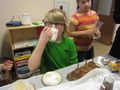
It's been interesting to see how students enter into the theme. Some went right to their "must-dos," completed them and then hesitated about what to do next. Others dove into the interaction with towns people. Many gravitated to the hands-on activities first then used conversations they had while working to guide their further explorations.
It is difficult for the students to formulate questions to glean information that is more "hidden." Josie Rawson, Laura Geisler and Kerry Hanifl have been volunteering as locals. They read up about the town their character inhabits and then caravan members have to ask questions in order to learn certain useful facts. (Download Antioch example of study guide). Some of the information wasn't on any of the information sheets students were using. But students didn't know what they didn't know… we had to volunteer a lot of the information.
After a few conversations, some students were beginning to get the idea and would ask more general questions: "So, is there anything I should know about Constantinople?" "So, what do you know about silk?" When they hit an area with some information, they would ask follow-up questions. How to ask good questions that lead to interesting conversations and learning will be a focus of this theme (and a useful skill for the years ahead.) We will do some explicit practice.
We ended our time in Constantinople by trading in the market place. Chara (Amy N.) and I (Yargos) listened to offers from the caravan members then haggled prices. Students based their offers on the information they had learned during their time in the town. Even during the trading, we were able to weave in information such as, "Oh, No. I could not sell an arena animal for less than 250. They come from far away, India I hear. I pay 250 for them…I will sell them to you for that, no less." Students who listened carefully were gathering clues about the resources that lay ahead and building an understanding of chains of trade. It is challenging and fun to share content organically, letting it arise from the roll play. When everything goes as planned, the students feel a need for the information they are finding and have a sense of discovery. They are not just being given information, they are uncovering it.
Next we're on to Antioch with its Norias (click on Silk Road Resources to the right for more info), apple tea, tyrrean purple, the Charonion, thermae, fine laurel oil soaps, mosaics, aqueducts, cave churches, naqaras, qanuns, and tuteks. We'll also continue to learn about the Byzantine and Persian Empires, the relationship between Judaism and early Christianity, the effect of conquest on religion and language, the perils of desert travel, and an ever deepening understanding of how trade influences the transfer of technology, culture, and resources.
Special thanks to Josie, Kerry and Laura who have been very flexible and jumped into roll play with both feet! They are making huge contributions to the experience.








 The Rookery
Leave a comment