Apologies to The Clash, I know it's "Rock the Casbah" but I keep singing it this way instead. It seemed appropriate for today's theme work where we were definitely rocking Kashgar.
Before recess we left Merv and crossed 200 miles of desert. I took the opportunity to use the big map we've been working on together so we could work some with scale. On the map, it was only two inches but it sure took a long time. We are only able to travel 2 miles an hour in the desert because of the high sand dunes — and we can only travel during the seven hour night so we crept across the desert, constantly fearful of bandits or sandstorms. We use dice to simulate the chances of disaster — it's a nice tie in to our recent work in probability. After the desert, we had to travel through some lawless land (chance of bandits = 1/10 per day!). We stopped briefly in the Fergana valley to buy some horses because we heard that the Chinese silk merchants were trading for horses. Then we tackled the dreaded Pamir mountains where the threat of snowstorms and ambush are constant. Luckily, we made it through unscathed with only a little frostbite and one unicorn sighting (that we're attributing to bad mutton).


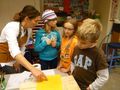
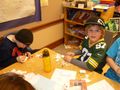
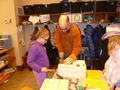
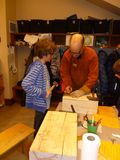 The bustling market of Kashgar unfolded before us and we were greeted by Ilya and Ughar, two Uighur bronze smiths who invited us into their workshop. Students created amulets to ward off bad luck by stamping the metal with patterns, rolling the plate around a dowel and then crimping and riveting the edge. It was very, very cool. Ilya even had a few lengths of silk to trade with the caravan members so they could wear their amulets home. (Many thanks to Josie Rawson and Stephen Mohring for creating the activity, procuring the supplies and teaching in the workshop.)
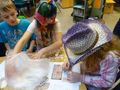
Across the market, the ivory workshop was also doing a bustling trade. Ivory came to the Silk Road from India and Kashgar is the main connection for the Indian trading spur. Caravan members scratched into ivory (soap, don't worry!) and then rubbed ink into the scratches. Many thanks to Kerry Hanifl for managing the workshop (and finishing up the massive clean up.)
Kashgar in 800 CE had an amazing array of cultures. While many European traders didn't make it this far east, Persian traders, Arabic traders, Indian traders, Mongol traders, Uighur traders, and Chinese traders all mingled in the marketplace. (The market, by the way, was usually held at night to avoid the heat of the day.) Christians, Jews, Muslims, Hindus, Buddhists, and Zoroastrians were all part of the population. The Silk Road has been called the first Internet by cellist Yo Yo Ma because of the global exchange of ideas, products, art, technology and language it engendered. If that's the case, Kashgar is certainly a hub of that ancient internet.
We'll be in Kashgar for a few days, gathering information about the road ahead. We're not sure which way will be the best way to go through the Taklamakan Desert whose name is said to mean either "The Place You are Abandoned," "Go in and You Won't Come Out" or "The Desert of Death." Whatever the meaning, this is definitely a daunting part of our voyage.


 The Rookery
Leave a comment