Data analysis and understanding is a crucial skill for being a modern citizen. People misuse statistics all of the time, and without a fluent and deep understanding of data collection, design and analysis, it can be easy to be deceived. Being able to read graphs and understand the data they represent is a first and important step in being a critical consumer of information.
Data handling lessons begin in kindergarten at Prairie Creek when children make simple bar graphs to represent responses to class surveys. By fourth and fifth grade, students are able to create circle graphs, line graphs, and pictographs and choose what type of graph is best for communicating the information they want to get across.
Deciphering graphs is equally important. The Herons will be working with a variety of graphs in the coming days to puzzle out what they mean. We started with the one of my favorites from the New York Times weather page. I gave them the page which has a series of these graphs for about twenty cities around the country (this one is today's from New York City – it's the only one available on-line):
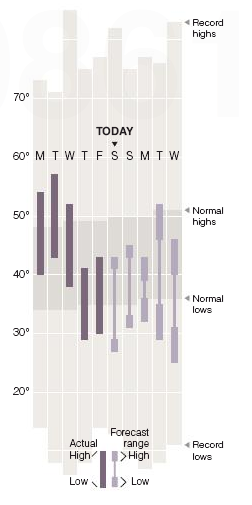
Students worked in pairs. I gave them no initial instructions except that the newspaper doesn't come with a teacher who explains everything to you so I wanted them to figure out what the graphs meant by themselves (the printed paper has a sample graph with the explanations above, but the city graphs don't have the explanations repeated.) After they had figured out how to read the graphs, they wrote two questions about them.
It took students a while to figure things out. Many didn't see the explanatory graph until they'd been working for several minutes. Some got the gist of the graph but didn't unpack it completely (there is a lot of information embedded in these little bars). Soon there were hoots of triumph as kids pieced things together. Then the comparing started – hottest, coldest…fourth and fifth graders have a deep and abiding interest in records — the tattered state of our Guiness Book of World Records is evidence.
We gathered to share questions. Some were the quiz show type questions I had expected:
- What was the high temperature in Washington on Tuesday?
- What's the coldest it's ever been in Minneapolis on March 12?
- What city has the warmest average temperatures right now?
- What is the average of all of the high temperatures on these graphs?
Others were deeper questions:
- How did they come up with the idea for this graph?
- How long does it take to make it?
- How do they make it? Do they use a computer? (I was intrigued by this one and did some research – see program here)
- Why does Minneapolis has a 60 degree range on the side but San Diego only has 20 degrees?
- Hey, I thought these were all state capitols, but they're not. How do they choose the cities?
- Why are there four cities from Florida?
While I should have expected these deeper questions, I hadn't (this is test prep season and I had some pre-assumptions about the direction of the lesson). Of course, I was thrilled. These questions highlighted a curiosity and wonder that could lead to new places.
The factual questions were important, too. We got a lot of practice working with the graphs while we answered them and many students more fully explored the graph features they hadn't fully understood when working independently. Indeed, I've spent years looking at these graphs, fascinated by the seasonal changes (I always celebrate when Minneapolis's temperature range shifts up a new 20 degree bar) and geographical anomalies (you want boring? look at San Diego's graph.)
Looking at graphs and data with your kids is a great habit to get into at home. It takes very little formal teaching. You puzzle out what the graph means together and then ask a single simple question, "What questions could you answer using this information?"
This technique comes from a math curriculum I use parts of called "ThinkMath" Finding questions to ask demands a much deeper level of thinking compared to passively answering simple questions asked by others. I hope you get a chance to try it out soon.


 The Rookery
Leave a comment