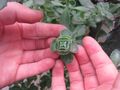
 The rain and snow held off for a wonderful day at St. Olaf, today. Thank you to Joe Gransee-Bowman for coming along with us to share his green building expertise. A huge thank you to Cassie Paulsen and Emma Fitz Chapman, the co-coordinators of St. Olaf Science Alliance. They organized a crew of students to work with the Herons and Kestrels as well as funded the bus to take us to campus. Cassie set up a full day of activities including tours of the wind turbine by Pete Sandberg, the St. Olaf facilities director who brought the wind turbine into existence. We also met with Professor Umbanhowar, the designer of the St. Olaf green roof. I felt so lucky that the Herons could spend the day with these remarkable people — when only 17% of Americans can name a living scientist, our kids were surrounded by them.
 We began the day with a nature walk around the St. Olaf natural lands (a great

place for a hike). We looked at invasive species and learned about maple sugaring. We also went geocaching and found Rings Around the Rotor. On the way back from the cache, L.A. spotted a decaying animal. The Herons' interest was piqued – sharp teeth, not a squirrel. Looks like it was dead for a while (maybe a week?) Skull completely cleaned out (maggots!). Didn't seem to be any other bones around (possibly eaten by owl?). Fur uniform color – brownish, no rings visible on tail (but it still might be a raccoon.)
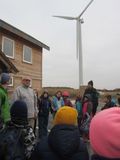
Luckily, our next stop wasn't lunch but the wind turbine where Pete Sandberg gave us a great tour, including a trip inside the turbine. The base is a wide concrete disk that weighs 2.2 million pounds. The turbine always moves at the same speed when it's making energy (14.3 revolutions per minute!) The blades feather to catch the wind just enough to move at that speed. The generator creates about 1,400 kwh per hour — enough to power the new science center. The students were especially fascinated by the safety mechanisms for the workers and the fact that, while a single cable could bring the electricity down from the turbine, that cable would be too heavy to support for the length of the tower so many smaller cables are used.
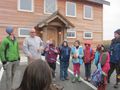

We ate lunch at the beautiful new Regents Building with a panoramic view of the Cannon River Valley and then we were off to see the green roof.
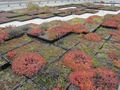
Professor Charles Umbanhowar gave the students (and me) a broad picture of the benefits of green roofs such water retention and filtering, as well as the cooling effect in urban setting. Importantly, we could get a lot of our very specific questions answered, too. Which plants survive best on the roof? Looks like our Hens and Chicks may be in for a rough winter – none of the original St. Olaf Hens and Chicks made it through the first year. How did they arrange the planters? How deep was the soil? (4 or 8 inches) Wait, is it soil (no! it's a crushed rock medium). Do they use fertilizer (they did tests and it looks like some fertilizer is beneficial in the first year.) Do they water? (No!) Do they cover the plants in winter? (No, but they have losses if there isn't a lot of snow.) What does snow do? Where did they get their nifty planters? We were inspired by the success of some taller plants such as autumn joy sedum. We were also amazed to see Professor Umbanhower stepping on the plants! They are evidently heartier than we thought.
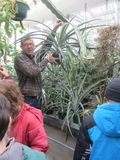
As if that wasn't enough, we then got to see the green houses full of succulent plants, cacti, bamboo, ginger, bananas, nutmeg, pitcher plants, ferns, pineapples, venus fly traps and, the class favorite, sensitive plant. We learned about how the green house controls the amount of heat in the building. The students and I were amazed by the incredible variety of adaptations we saw — we even got a few clippings to propagate at home.
Now we're full of ideas and questions, our engines fully stoked for the work ahead. Thanks again for all who made it possible.






 The Rookery
Leave a comment