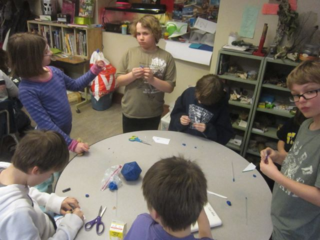
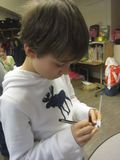
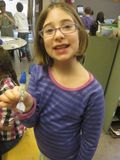
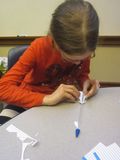
 Many of the Herons wrote at the end of our computer science theme that they really enjoyed figuring out how to do things for themselves. As we began our straw rocket theme, I wanted to honor that. I gave them a straw, some paper for fins (if they wished) and some clay for a nose cone. The only restriction I gave them was that one end of the straw had to be free of clay so we could launch the rocket.
The Herons dove in. They were taping, sharing, drawing, scheming. About five minutes in, one child asked, "What do we want our rocket to do?" She asked this after seeing a friend's design that involved a flat wing like the space shuttle. Everyone stopped creating for a moment and waited for the answer to the question they knew they should have thought of earlier. I explained that our first rocket would be used to test the affect of force and launch angle and that we would be measuring the distance the rocket traveled.
"Got it." Everyone got back to work. Curiously, no one seemed to change design direction much.
Today we ran the force test, launching our rockets straight up with 5 cm3, 15 cm3, 25 cm3, and 35 cm3. We graphed the results. Very quickly, kids were thinking about modifications, "Mine's too heavy, it didn't even move with 5 cubic centimeters!" "The wings pull it sideways instead of letting it go up." It almost killed some of them not to change the rocket between launches but I wouldn't let them. "Why not?" I asked. "BECAUSE YOU'D BE CHANGING MORE THAN ONE VARIABLE!" they chorused back. I beamed like a proud parent.
Tomorrow we'll launch the same rockets with a constant force but differing launch angles. We'll also be learning about forces, trajectories, propulsion and some of Newton's laws. Then, we'll use what we learn to design a new straw rocket that will be able to hit a target accurately.






 The Rookery
Leave a comment