 We began our exploration math by, well, exploring pentominoes. In this blog entry I want to share what the class did and then show, in bold, the math habit that we (teachers) were working to develop.
First, we began by establishing a definition of an "-omino." An -omino was a set of square tiles where each tile had to share at least one entire edge with another tile. At least that was our first definition. As we worked to find tri-ominoes and then tetraminoes (think "Tetris") we realized our definition needed more specificity. An -omino had to be flat, not three dimensional (although that would be interesting to look at, too.) An -omino had to be connected. One couldn't have a pair of tiles unconnected to another pair of tiles, for example.
Creating common definitions is something mathematicians do. They work to hone definitions so that they are clear and unambiguous. In looking for exceptions to the rule, we understand more about the rule.
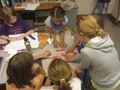 Students were challenged to try and discover all of the possible pent-ominoes (shapes with 5 tiles). Now we had more defining to do. Would we count rotations as the same shape? Yes. And reflections? Yes, after a little more debate. One child wondered if you could figure out how many pentominoes there would be by looking at the number of -ominoes we had found with fewer tiles. Another predicted that we should double the number of tetraminoes. I made a table on the board so we could look for patterns – 0 shapes with 1 tile, 1 shape with 2 tiles, 2 shapes with 3 tiles, 5 shapes with 4 tiles. Another child noted it wasn't going up at the same rate. "Factorials!" another student ventured. This was a direction we weren't ready to go as a whole class but I smiled and asked him to do some testing when he got a chance.
Mathematicians predict and test. Mathematicians look for patterns. Mathematicians keep track of their work using structures like tables. Mathematicians change their conjectures (math hypotheses) as they gather more information, especially counter information.
 As students looked for all of the possible pentominoes, I pushed them to prove to me that their answer was all of the pentominoes. How did they know? This was a challenge for students. Many had used random approaches to finding shapes – the guess and check "method." Several began to use words like "shift" to explain how they went from one possible shape to the next.
Mathematicians strive to use systematic thinking. Mathematicians strive to prove things they have hunches about.
The next day the students shared all of the shapes they found and worked together to determine that there were, in fact, twelve shapes.
Mathematicians talk, communicate, debate and share results.
We then began to explore which of the pentomino shapes could be folded up into an open box (a cube  with one face missing.) We used our visualization skills to make hypotheses and then built the boxes out of pentomino shapes to confirm (or disprove) our hypotheses. Several students tried to define which type of pentominoes wouldn't work. Students were asked to keep track of how they were categorizing their hypotheses and their tests. Many circled those they thought would work and then put a star in the circle when they did work. Whatever method they chose, I insisted that they provide a key to their symbols so they would be able to come back to their notes.
Many kinds of math require manipulating shapes in our heads. Mathematicians make hypotheses and test them. Mathematicians work in an organized, clear way. They strive to make their thinking clear to others.
Finally, today, we took open boxes (cleaned out milk cartons with the top cut off) and groups worked 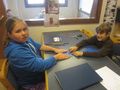 together to go backward and make cuts to create the pentomino shapes. I assigned each group a pentomino shape to make by cutting along an edge. They had to agree as a group to each cut before it was made. They did a remarkable job – by carefully debating and discussing before each cut, every group was successful. I did one for the whole group (the easiest, turning the box into a plus sign pentomino) and one child noticed that I made four cuts. He wondered if each shape would take four cuts. I polled the class – what were their hunches? Many thought the number would change. Several thought it would always be four. Others weren't sure.
Mathematicians collaborate. They communicate and use shared language. Mathematicians make observations and make predictions. Mathematicians test.
 It quickly became apparent that, unless there was some very strange probability at work, each pentomino really did just take 4 cuts. Why? One child pointed out that if you just make 3 cuts, you still always have a three dimensional object. Another pointed out that if you make 5 cuts, you are always cutting the pentomino into two pieces. Another observed that the open box has eight edges and all of the pentominoes we were trying to make had 4 shared edges. 8 box edges – 4 cut edges = 4 remaining edges (the number that each pentomino needed).
Mathematicians push themselves to figure out why a pattern happens. They test other possibilities to see what happens. Mathematicians use numbers to make sense of the world.
Activities like these are called "Low threshold, high ceiling" meaning that students can get engaged with the ideas easily and the concepts can be expanded to challenge all students (even adults). No matter the level of complexity, each learner is practicing the habits of math.


 The Rookery
Leave a comment