 Last Tuesday, I was asked to speak to a Carleton educational psychology class about constructivist learning. (Lest my head get too big, the guest speaker before me who was the professor's dog who demonstrated behavioralism.)
Constructivist learning is at the heart of the progressive classroom. Essentially, it posits that students construct learning within their own heads. We cannot simply program them with information. Instead, they must be active builders, putting things together and, when new information doesn't fit within the schema or framework they've created, taking things apart to re-build. It can be a messy business but it is a process deeply respectful of the students. I cannot make anyone learn, only the student has the ability to construct understanding. It is my job to create an environment rich in the building blocks they'll need as they figure things out. It is also my job to create a safe environment where the experimentation and curiosity necessary to construct understanding is celebrated and protected.
I spoke specifically about Village – and about the powerful understanding of citizenship (and economics, and monetary systems, and governments, and banking, and businesses, and using a hammer…) that students construct as they build a society that is very real to them. They seek information out because they feel a deep need for it.
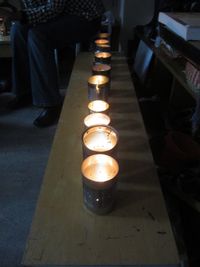
So, while I was off sharing how our school uses constructivist methods, a stellar crew of volunteers was putting them into practice in our colonial swink. We created lanterns and candles and just this Tuesday we made Jacob's ladders, a colonial toy that required a lot of patience and precision as we worked.
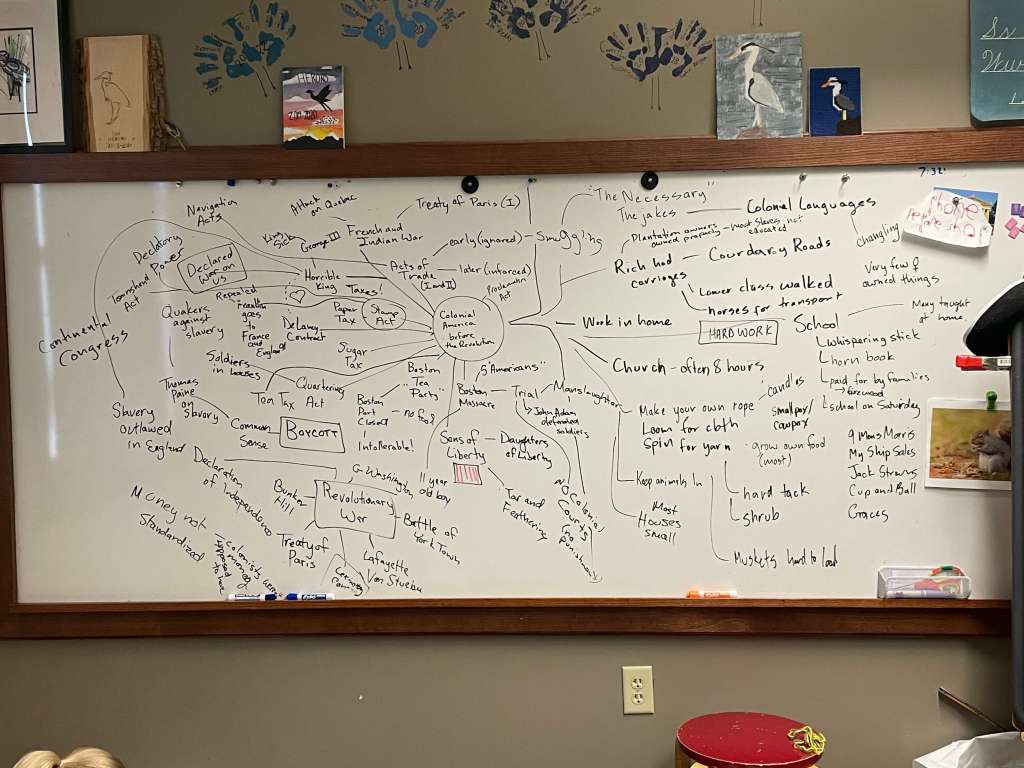
In our role-play, Boston and the colonies are being punished by the king – Boston port is closed, people are not allowed to gather in large groups, and British soldiers cannot be tried in colonial courts. Some colonists have gathered together in Philadelphia to write a letter to the King to urge him to reconsider – in the same meeting, they begin to plan militia in each colony who could provide protection from…the British troops. These are confusing times. Did the ruffians in Boston go too far? Does the whole town deserve to be punished? Does the King have the right to keep you from gathering with whomever you like? Are the colonial courts fair? The students are truly beginning to realize that it is confusing to live through history — our history books usually share a single storyline, one that isn't clear when one is actually experiencing the events happening.















 The Rookery
Leave a comment