There can be a lot of pressure for a school to adopt the latest technology. iPads for every kid, Smartboards in every room – once one district does it, it can seem like your kids are at a disadvantage if they don't have the same stuff. I am not a Luddite but neither do I believe that technology is great just because it is new. How does the technology enhance student learning? What does it do that I can't do? Without compelling reasons to use a technology, the money is best spent on student learning in a different way.
There are technologies, however, that are transformative and Google Drive has been one for us. We piloted it last year and this year have hit the ground running. Each child has an account in which to create documents. Students can also share documents with others – either to view or to edit.
When we worked on publishing some of our writing this past month, children shared their piece with me when they were ready for an adult edit. I could make suggestions in the margins which children could then read and apply to their piece. What would have taken two weeks to do in writing conferences was done in a single day (I could write comments at home for students to respond to at school.) Students received immediate, useful feed back.
A huge and unexpected benefit of Drive has been the sharing of student work with each other. They encourage each other and provide an audience for each other's writing. This is the reason we write – we want to communicate with others. It is very authentic. I love reading the supportive comments of students "This is hilarious." "I can't wait to read what happens next."
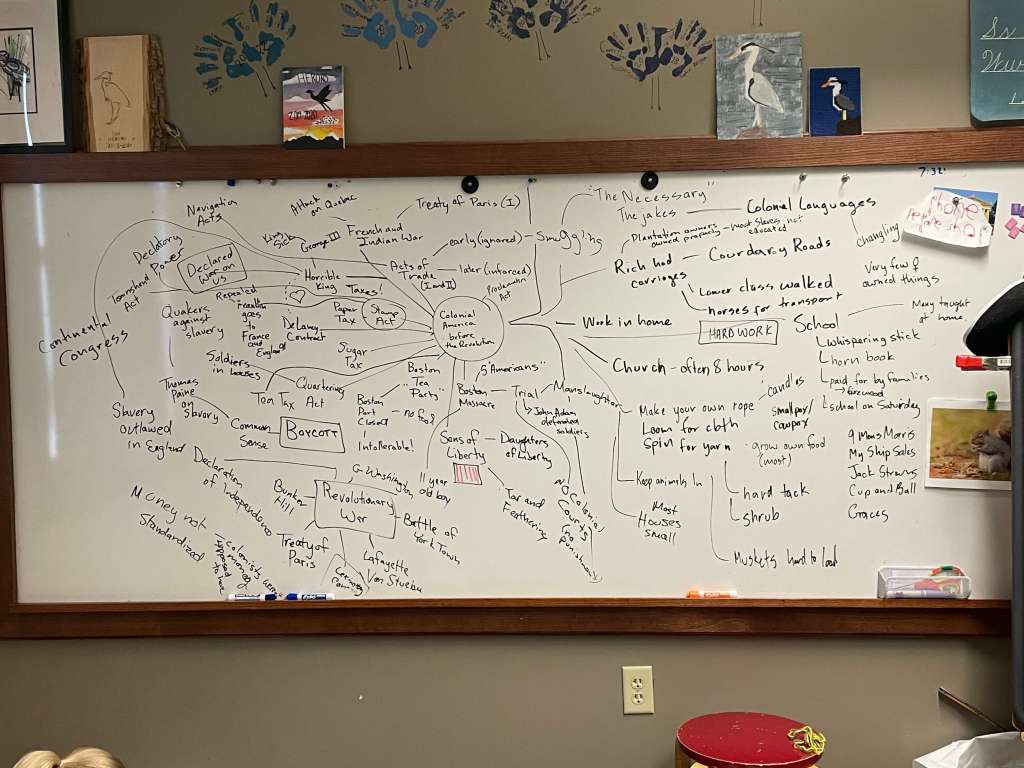
Finally, I love the opportunity to do group writing with Drive. We wrote our Colonial play together using Drive. We decided that we wanted to transport the audience through time – learning about each of the major events leading to the Revolutionary War. First we brainstormed and laid out the organization in a document together. Then groups of children each wrote about one event – sharing what happened and then having various characters react to the news. We wrote simultaneously (often reading others' work as we went.) The room buzzed with activity as students surveyed each other to see how they would respond. It was a great chance to assess students' learning so far as well as to re-enforce what we had learned. We read the result, shared revision ideas and then a small committee came together to revise and edit the whole play.
This level of collaboration in which all twenty one students have an active role in such a short time would be impossible without the use of technology.
As we've explored Drive, we've also been learning alongside the students. Sometimes there is conflict around a shared document or around comments that someone has written. We welcome these opportunities to talk to students about life on-line. Indeed, this is part of what the social curriculum looks like in 4th and 5th grade. As their world widens from Prairie Creek, their skills need to deepen and they need to be able to apply what they've learned about being a good friend and citizen in a broader context.
A misunderstanding among some children recently gave us the chance to write a guide for group writing on-line. The students were excited to receive some guidance — it can be difficult to navigate group work situations, especially when one has to rely on text to gauge people's feelings. You can read the guidelines we developed together: Download Co-WritingEtiquette.
This is an exciting time to work with technology in education. At Prairie Creek, we work to stay on top of what is out there and make good decisions about what we bring into our classrooms. Often, as with Google Drive, the result of this care is that the technology allows us to do things we were never able to do before.


 The Rookery
Leave a comment