 No, this blog isn't about our recent puberty education conversations* but instead about our personal projects. On Monday, Cathy and I had the pleasure of speaking about the honors project (and by extension the 4th grade project at the Northfield School Board meeting.) It was our annual report to our authorizer and we wanted to highlight a part of our program that we felt was innovative and could contribute to the district's work.
At Prairie Creek, personal projects are authentic, real research. We don't set out the topic for the students and tell them what they must find (although it would be infinitely easier to say that everyone had to do a biography and find the birthdate, birth place, and three significant accomplishments of a famous person.) Instead, we work with students to find good topics. Do you know enough to ask good questions? Do you know too much to be curious about a lot of things? The topics in the Herons are very, very diverse: wrestling, the United Nations, Lego, Walt Disney, the Seven Wonders of the World, Steven Hawking, Sea Myths, electricity, aquaculture, candy, theater, manga, chickens, tornados, spies, big cats, vikings, Julius Caesar, cake, special effects and chocolate. Finding resources can be a challenge – but that's part of the point. How do you learn about something new? Where do you look? How do you find things?
Students ask questions about their topic, pushing for deeper questions that will require synthesis of information. In kindergarten, the scope of their project was finding 3-4 facts. Now the expectations are far greater. Doing a project each year enables children to build sophisticated skills. Students categorize their questions and begin looking for answers. Importantly, they don't stop when they find an answer. They know that, because they will be teaching, they need to know the information that surrounds the answer, too.
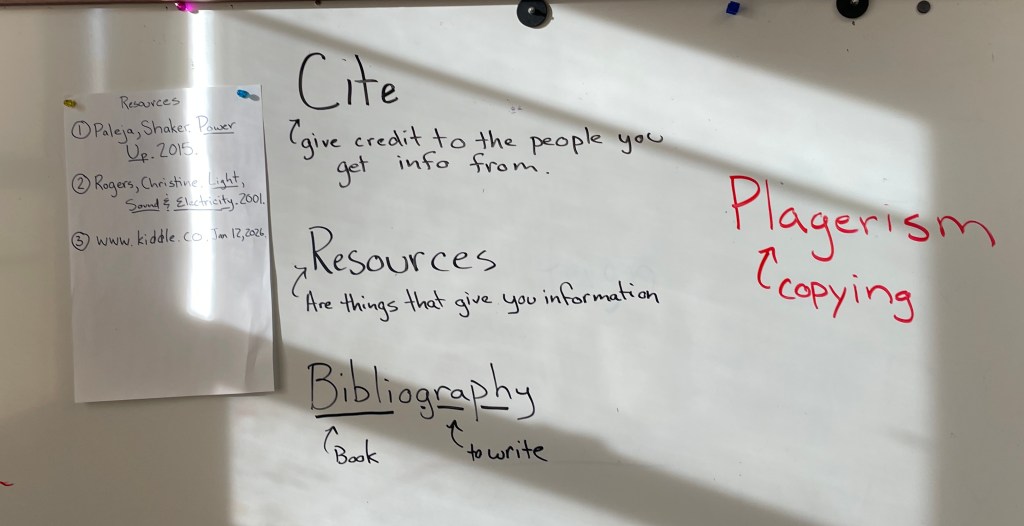
We learn how to take notes. It is, for most, the hardest task. Some students write down everything making it very hard to find one's own voice when writing later. Some students don't know what is important enough to write down. Some students write down too little and end up digging back through books finding the piece of information that they think they read. Many students struggle to write down only what they truly understand and can put in their own words. We encourage students to read, close the book, and then write down what they think they might want to teach to others (perhaps peeking to get a spelling or a date right.)
As our pile of note cards grows, we take occasional stock of what we have and what we might still need. In a recent mini-lesson, I developed the metaphor of a tree with the students. Each of their categories was a main branch and the questions, perhaps, smaller branches from each category. The notecards were leaves. Which branch had many leaves? Which branch had only a few? If the branches were uneven, it was time to look for a resource or a part of a resource that could help you fill out the leaves of that branch. Sometimes, we think a branch might be a good idea but then we can't find any information or another branch gets a lot stronger. We can lop off a branch and split another into two different main branches if we need to. It's important to give children permission to allow the focus of their research to evolve.
And this is one of the reasons I love project time. As students realize that they are empowered to make the decisions, they begin to take their work very seriously. This is real. They will be the expert. They will be teaching us.
The 4th grade project exactly mirrors the honors project except that it is "mini". Instead of 5-10 pages, students write 5-10 paragraphs. Instead of speaking for twenty minutes, fourth graders speak for five. The 5th graders serve as mentors for the 4th graders, teaching the skills that they themselves are using. Teaching is a great way for students to solidify their understanding of what they are supposed to be doing.
I could go on and on – indeed, I did on Monday night. But I will stop for now. We invited the school board to visit us during honoring week and I'll extend the same invitation to you. 4th graders will present their projects on April 6, 7, or 8. We construct the schedule based on the 5th grade presentations which also happen that week so we don't know exactly when each 4th grader will present until about 2 weeks prior.
As I told the school board, honoring week is an amazing time when the school is filled with students sharing their passions. There is a palpable feeling in the air that there are an infinite number of things to wonder about. There are an infinite number of questions…and our kids are learning how to find the answers.
*(footnote from first paragraph) Although those conversations went very well. My favorite moment was reading an anonymous question on an index card that asked, "How do girls [sic] voices change? I think they get stronger."









 The Rookery
Leave a comment