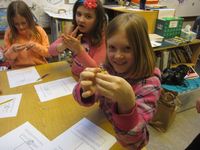
 On Monday, we began a new electricity theme with a seemingly simple assignment: using a paperclip and a battery, make a lightbulb light. The Herons were asked to record every solution they tried and note whether it worked or not.
Most thought that it would be easy. But soon I was inundated with complaints – batteries weren't working, bulbs were broken. Nothing was working. "Show me what you're doing," I said to group after group.
They would show me their idea – often the paperclip connected to the battery at one end with the lightbulb at the other end of the paper clip. "Hmmm…I'm not convinced that your lightbulb isn't working. Keep trying different ideas."
Soon one group exploded, "IT'S HOT!!" They had connected the paperclip from one end of the battery to the other. Now we had some additional data – something was happening, but what?
Eventually all of the groups created a system that worked. It took a lot of trial and error – and a lot of 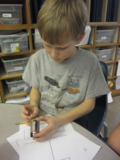 careful observation. It wasn't until most groups really looked at the lightbulb that they began to think about where the wire was touching the lightbulb.
They ended the hour with a very good idea about what a circuit was and what it wasn't. Curiously, many
had played with Snap Circuits or similar activities in the past but they had not really analyzed just what was happening when a circuit worked. Had I just given them the instructions to build a circuit, they would have remained uncertain about how the electricity worked. This simple experiment forced them to try a lot of different ideas and through failure identify what made a circuit a circuit.





 The Rookery
Leave a comment