I think this is the first time in my career that we have been simultaneously working on four themes – none of them small. The room is crackling with energy and enthusiasm. It's a lot of fun.
Heart of the Beast – our puppets have come out beautifully. We were able to work with Esther and Madeline four times – slowly building our unique puppets out of clay, newspaper and paper maché. Today the students learned some basics of puppeteering and they'll share their work at our True Colors night on Thursday. The fourth graders have made masks of herons and the fifth graders have created seven to ten foot puppets of a heron, an egret and a dove. These giant puppets take four puppeteers to operate! Many years ago, we tried to make giant puppets for a May Day celebration – it's been great to learn from professionals how to make giant puppets that work and are beautiful (ours ended up in a mushy pile about a quarter of the way around the May Day parade route.)
Electricity – The Herons are putting together "ZAP – an electrifying experience" to teach you (and the rest of the school) about electricity. We began by brainstorming what we had learned during our theme and then choosing from that list what we wanted to teach others (this kind of brainstorming serves as a review of our learning.) Then we collected the activities that we thought would work to teach the key things we wanted people to learn. Students shared their top four choices with me and I placed them in groups where they have created a plan for their exhibit and are in the process of gathering materials, testing the activities, researching further information (for informational posters and answering guest questions), and creating signage. Culminating events are a crucial part of the theme experience. Students get to review what they've done and cement their understanding by teaching others. In addition, culminating events plant the seeds for learning in other classes. I wouldn't be surprised if one or two students were inspired to study electricity for his or her personal project. PLEASE COME to ZAP next Tuesday any time between 12:30 and 2:00!
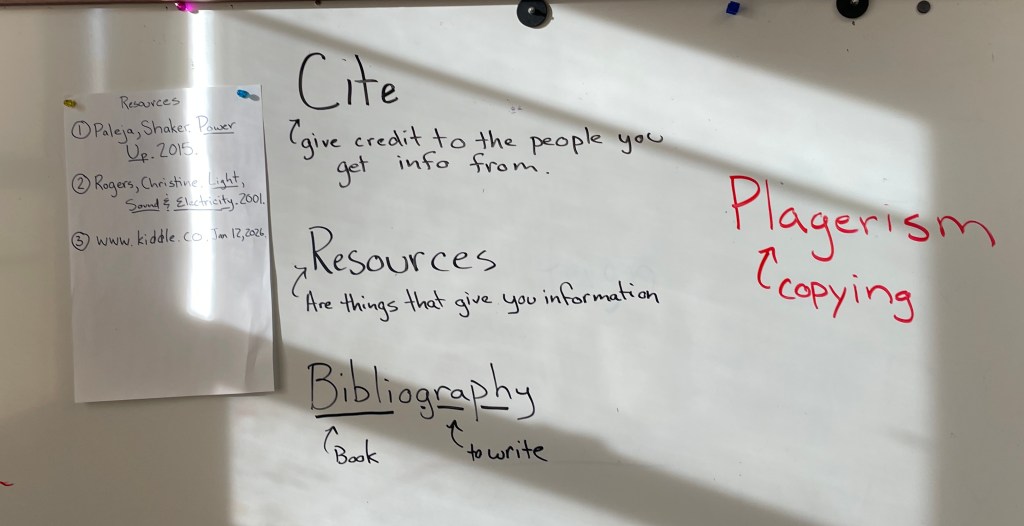
Personal Projects - The fourth graders are well into their writing right now, organizing their facts into paragraphs. It takes a lot of practice to create a cohesive essay and students are learning how to review their information and put it in an order that make sense. I then encourage them to take a paragraph's worth (a subtopic, usually) and read the notes to themselves in order. Then they put the notes to the side and share the information with a friend. This process of articulating things orally helps shift the language from the short hand of note cards (or, occasionally, the copied language of note cards) to the student's own expression. After sharing the information orally, students turn right to their Blue Book to capture their words on paper. Then, when they revise with their mentors or me, we re-read what they've written and make sure that every paragraph has a single focus and that the information makes sense. After the body of the essay is completed (what we sometimes call our meaty middle patties), students go back to create the introduction and conclusion (our buns). This helps students overcome the blank page freeze that can occur when we try to start with the introduction without really knowing what we're going to end up saying.
A lot of students express amazement at their ability to write non-fiction. For some, it is a relief to not have to make up ideas from scratch as they do when they write fiction. The content and organization of non-fiction is a much more apparent to many young writers.
Next up in our process? Revising, editing, and the visual!
Fifth graders have been busy mentoring their fourth graders but they have also been working on an essay about their trip to Wolf Ridge. They can choose to write about a single event and three habits of mind they used at that event or they can write about a single habit of mind and three events that tested it. It is very, very hard for the students to not write a chronological retelling of their time at Wolf Ridge. Most essays go through two or three revisions while students cut unnecessary details. It's great practice to help them develop a sense of what a focused paragraph is.
Mammal March Madness – I had been putting together a theme about birds and bird adaptations for after electricity when an NPR story stopped me in my tracks. An amazingly goofy but scientifically fact filled March Madness bracket based on mammal pairings and head to head combat had been created by some evolutionary biologists in Boston. I shared it with the Herons and they were as psyched as I was. Yesterday, we talked about adaptations – how they occur and the different ways they can help an individual survive so that it passes on its genes to more individuals. Today we spent an hour researching the brackets and making our class picks on which mammal's adaptations would make it successful in a head to head combat against another animal. Some of the competitions were really tricky – what if an animal was an herbivore with really good camouflage? What if one competitor was huge but its opponent was really speedy? The conversation about what makes a species successful has been rich and wonderful. You can do your own research using and you can also follow the play by play.
And we are also:
Our math theme has focussed on symmetry, reflection, rotation and translation. We've had some wonderful conversations about the symmetrical patterns we can make by coloring in different numbers of cells in a set design. It sounds simple – and at one level it is. But one can also start to look for patterns in the number of designs and the number of lines of symmetry. Students soon saw that certain patterns were able to be rotated to create multiple designs. Did they need to draw all of them? Students had to think about how they would know they had found all of the possible designs and many developed systems of creating designs that were not random. How could we collect our data in an organized way so that we could see patterns? Some students became fascinated by exceptions to the rules we thought we had found – if something didn't follow the pattern, why didn't it? We spent several days exploring the ideas were were uncovering. This kind of activity is sometimes called "low threshold, high ceiling" meaning that every student, no matter their experience, can engage in the challenge and make some discoveries. The activity is rich enough to continue to challenge students in increasingly complex ways (indeed, I spent a staff meeting sketching out possible solutions and trying to find a pattern!) It also teaches students to think like mathematicians – looking for patterns, organizing one's work, seeking deeper structures, hypothesizing and testing.
And we wrote a pretty great poem about Herons:
Olivia challenged us to write a poem about herons to use in some composition work in music. I had the Herons analyze an Emily Dickinson poem for its rhyme and meter (she often wrote in common meter – alternating rhyming lines of eight then six syllables.) This meter is often used in songs (The Yellow Rose of Texas, Amazing Grace, the Pokemon theme song, Gilligan's Island.) Here's our poem (as yet untitled)
The Heron
Angel like, the heron flies
then settles in the reeds,
And stays quite still until it spies
A fish – on which it feeds.
A silent splash, a lunge, a spear –
the heron snares its prey.
In one quick gulp no longer there;
that is the heron way.
Then rising slow with pulsing wings
It lifts into the sky.
And from that spot there ripple rings
That edge the pond and die.


 The Rookery
Leave a comment