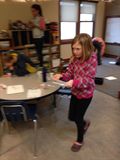
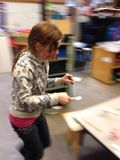
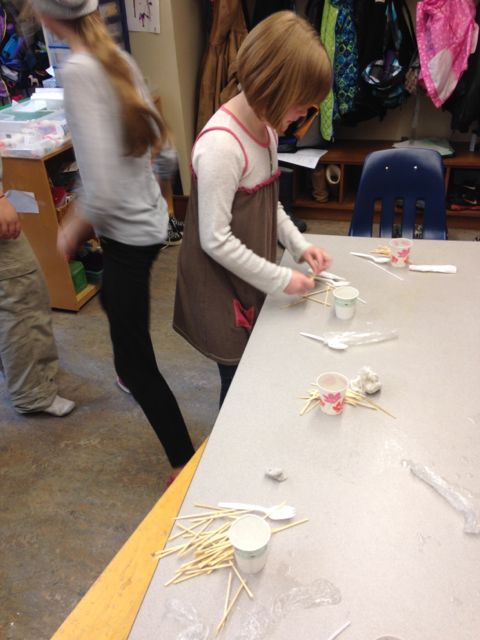
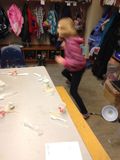
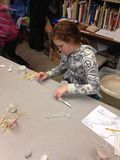
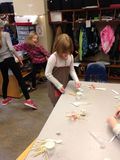
Just what does it take to survive? Water, food, and shelter. On Friday we ran a simulation to find out just how hard it would have been to make it as an early human living in the Fertile Crescent around the same time as farming was first being figured out. Students had to fill a spoon with water from the "river" bucket in order to fill a cup on their desks. They had to find at least 20 "food units" either by hunting or by learning how to farm (knowledge gained through a multiple choice test). And they had to build a shelter – taking one "log" at a time from the forest back to their base camp. One had to do all of this in 30 minutes. It was hard – some students didn't make it.
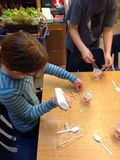
As we talked about the experience, students talked about the advantage of living near the water bucket. Others had easy access to the "forest." Students who tried to hunt talked about how much luck played into getting enough food. True to their Prairie Creek selves, they brought up things that weren't in the original simulation. Could you trade? Could you make tools? (I had been lazy and had given them spork packets from lunches instead of tracking down plastic spoons – the Herons instantly saw that the straw and the napkin included in the packet would be very useful. Even the bag it all came in was put to use.) Could you raise food for someone else? They wanted to add some more reality to the simulation – what if the kids nearest the river had to roll a die to see if they were hit by a flood? What if you had to roll a die to see if you got sick?
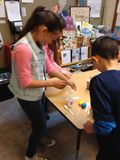
The next day, students worked in small teams to get all of the tasks done. The year of this simulation was about 2,000 years later – larger scale farming was the norm and one farmer student could get all of the food for the village. Students had the option of following instructions to make a pottery wheel (simulating invention) and then "making" a bowl to transfer water in. Clay could be gathered from the river to aid in the building of houses. Several villages set up "bucket brigades" to move the logs more easily to their village site. All of the villages got done with time to spare – they started to create new things. Language. A well. A fishing pole. Writing. A harp. A swing set. Domesticated dogs. The lesson of the simulation was clear: once humans could cooperate and organize themselves to do large tasks, they had the time to create culture.
As we discussed the experience, the students were filled with questions (see the blog below). When did people first trade? How did they get to the fertile crescent? When were boats invented? When was counting invented? When did people use money? Did they have ownership? When did people steal?
Now we are on a quest to answer some of those many, many questions. We've set up a very long timeline and students are using some of our books to find "firsts" and chart them on the number chart. Already we've discovered discrepancies and it will be fun to talk to the students about how discrepancies for these "firsts" could happen.






 The Rookery
Leave a comment