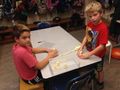
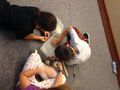
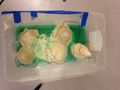
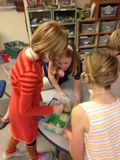
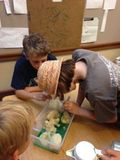
 As part of our river theme, students made topographical maps by creating land masses out of play dough in a plastic bin. They then add water one centimeter at a time, each time tracing the "shoreline" on the land mass by using a transparency across the top of the bin. These tracings are the contour lines of the land mass. The resulting maps are a revelation for students – they really can see how the structure of the land affects the way that water flows and collects. One group was very excited to create a cave in their land mass. We had several interesting conversations about whether or not a cave wold be visible on a topographical map. (Incidentally, cave maps are very cool.)
We have also begun writing circles. Children are in groups of four and they choose a theme for the week's writing. I provide mini-lessons on a variety of topics from trying new genres to using strong verbs to revision techniques to the wonders of the comma. Students keep their writing a "secret" as they work so they can surprise their group mates when we share at the end of the week.
Writing circles give students a small, trusted audience. Students are taught how to listen carefully and critically. Students feel accountable to each other – they really want to have something to share. When they share, they receive feedback from their group-mates both about things that are working and concrete suggestions for places that might need more detail such as adding character thoughts, expanding a description, clarifying a confusing part or slowing down the action.
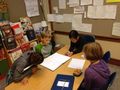
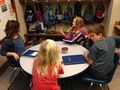
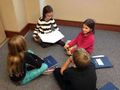
We also did a "quick write" this past week. Children write as much as they can in 10 minutes. The point is to keep the pencil moving, no matter what. I emphasize that the words we write in first drafts are never the perfect words. Writing a lot of words means that it's a lot easier to change those words to make them better.
Speaking of things that never work when you first try them: we did some work with the computer programming language Logo this week. In programming, failure is simply an essential part of the creation process. We talked about how "failing" is a chance to gather information about what might need to change in the program. The rewards for persevering are great – soon, colorful stars appear on many screens. It's also a great way to apply in a very real way the work we've been doing measuring and drawing angles.
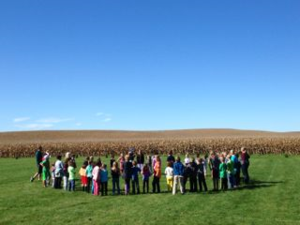
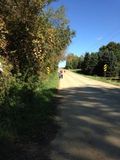
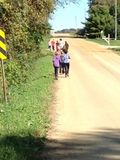
Our gym theme right now is cross country. We focus on a particular game or activity for about a week at a time and I ask the students to set a new goal for themselves every time we play – something concrete and small which they want to work on. For cross country, students focus on personal best goals – running a little farther before they walk, using positive thoughts to motivate themselves, finding a steady pace to run. During our first run, the Herons who had finished the route cheered for those who still running. It was great to see how they were encouraging each other. Here's a neat map of Dakota county where your child can show you where we ran (and measure it using the tool feature.) http://gis.co.dakota.mn.us/dcgis5/

 The Rookery
Leave a comment