The school year has its rhythms. In the Herons we typically wrap up a very large theme in late December and then reflect and recuperate in early January. This is also when I am writing narratives about each child – a joyful but writing-intensive process that leaves other forms of communication neglected. I have a lot to catch up on!
Mentors and Mentees – The Beginnings of the Project Process


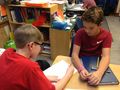

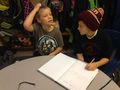
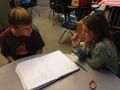
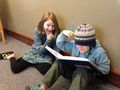
Just before break, students were paired up into fourth and fifth grade partnerships. Each fifth grader shepherds a fourth grader through the fourth grade project. The process mirrors the honors project – everything is just "mini." For example, instead of four to five star questions, fourth graders develop two or so. Instead of a tri-fold visual, fourth graders create a small poster…but I get ahead of myself.
One of my favorite things to do during work sessions is to listen to the advice the fourth grade mentors give their mentees, "Keep track of your resources as you work…it's really hard to get all of them later!" "Don't put too much on one note card, it's easier to write with less on a card." It's all excellent advice, and, importantly, when fifth graders reflect on their own experience last year, they are much more likely to apply what they learned about the process to their own work on the honors project.
The fifth graders take their work very seriously. They benefitted from their work with a mentor last year and feel a responsibility to honor the work of their mentor by being a good mentor themselves. While the honors project is done primarily at home, the fourth grade project is done entirely at school. We begin every work session with a mini-lesson focussed on the part of the process the on which the students are working. Sometimes, the lesson is applicable that day, sometimes it's meant to be used as needed.
So far students have chosen projects and they have developed questions. There is an evolution in project scope. When students are in K/1, they are often answering five to six simple factual questions, "dot" questions that can be answered in a single sentence. By fourth grade, the expectation is that students are exploring four to five "dash" questions that require multiple sentences and resources to answer. Gathering answers to "dot" questions is still a part of research but is now part of gathering background information.
We have also used a variety of metaphors to think about categorizing and grouping our questions. This helps to broaden the question areas out enough for students to be effective researchers. Developmentally, students are still concrete enough in their approach that, if focussed only on their questions, they will often claim they "can't find anything" when they are researching. What they mean is that they have not found a sentence that directly answers their question. If, however, they are looking for information related to a broader category they are more successful. Of course, that information will often be a part of the eventual answer they are seeking.
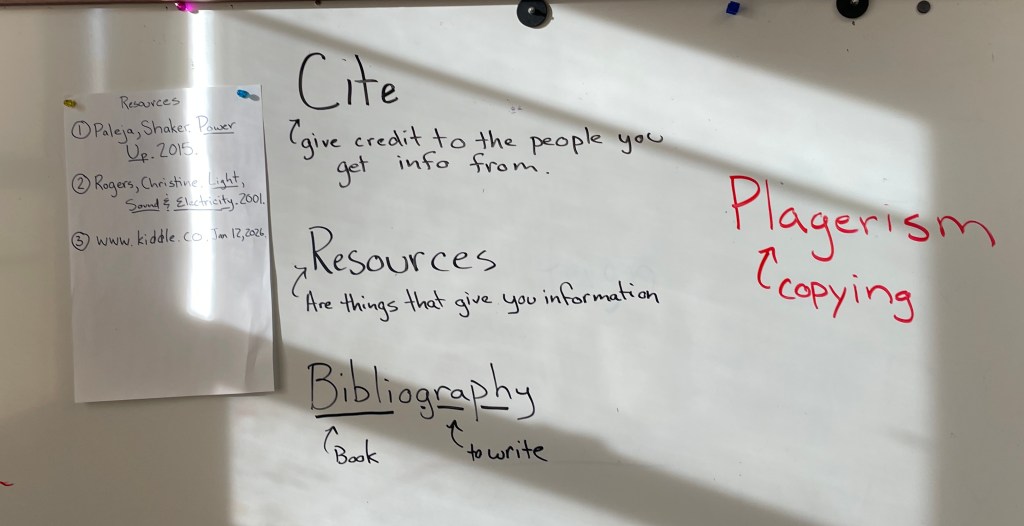
Students have also learned how to keep track of their resources and take notes while they are reading. We use a simple numbering system to keep track of where information comes from – the beginnings of the citation process students will use as they get older. While we don't have students cite work directly in the papers they write using footnotes or parenthetical citation, we make sure we emphasize the importance of giving credit to the authors and sources that teach you.
Whew! That gets you up to date on the project process.
Computer Programing and Coding


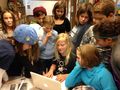


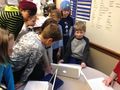
Why learn code? The biggest reason for me is that it's as close to teaching at Hogwarts as I will ever get. Code is magic. One types a series of letters and symbols into a window on one's screen and then, when one tells the computer to "read" the commands, the computer follows the instructions. So much of our time with technology is spent pointing and clicking. We are in the thrall of the technology. It is so exciting to pull back the curtain and see what is going on and even take over the controls.
The second reason we learn code is that it's an authentic opportunity for me to learn along side the Herons. So often they'll be struggling and the only thing I can do to help is to come and struggle with them as we watch a tutorial or read about a command to see what is going wrong. I get to do a lot of modeling of how to approach problems and how to react when something is frustrating. We talk often about the growth mindset and how important it is to find things that are hard at first. But the truth of the matter is is that I don't struggle with long division or identifying metaphors versus similes. It's all well and good for me to say "your brain gets bigger when you struggle." But with coding, we really are learning together in all the messiness that that implies.
Coding is also a distillation of the scientific method. One hypothesizes, tries out the hypothesis, analyzes the result, then modifies the variables. It's textbook critical thinking – the kind of thinking that will be necessary for students no matter what field they go into. When you code, you break down a larger problem into smaller pieces. You think through what you need the computer to do in a methodical, step by step way. And then, when something doesn't work (and something always doesn't work at first) you think through your program step by step to figure out where things went awry. These are all crucial skills.
And the final reason we learn code is that it is a whole lot of fun. It's a puzzle to be twisted this way and that until you can make sense out of the pieces. Like most real life problems – there are a lot of different ways to solve things.
I encourage you to sit down with your Heron and try out some of the activities in our coding section (in the side bar to the right.) It's a pretty great way to spend a frigid afternoon.
Arts Residency – Ceramics with Colleen Riley
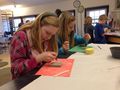
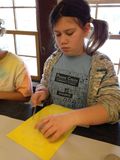
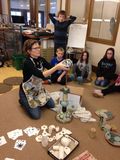
 As you've seen in Simon's posts, the school is busy with a ceramics residency with local artist, Colleen Riley. The Herons have learned a lot about working with clay from Colleen and they have been busy working on their contribution to the larger art pieces that are going to be installed and unveiled at May Day. One of the most valuable parts of the residency has been the notion of collaborative art. The students are not working on their individual piece, they are contributing to a larger piece. Working with clay is a slow process. We complete something one week that becomes the base for the work of the next week. Colleen doesn't say, "take your piece from last week," she says "take a piece from last week." When the sculptures come together, we will all have left our mark, literally, on each element. It will truly be "community art."






 The Rookery
Leave a comment