 "Oh! I have a skull! Come quick." "What is this?!?" "COOL!" "Ewww…" "MICHELLE! COME HERE NOW!" "Intact vertebrae…I have intact vertebrae!" "Dude!" An audio feed from our owl pellet dissection yesterday would have been a hoot. (Sorry.) There was a lot of enthusiasm as students' owl pellets revealed treasure after treasure. For some, it might have been the highlight of the year.
Continuing our informal study of how bodies get rid of things we eat but can't digest (my "fourth" grade model project this year was on scat), the Herons dissected owl pellets yesterday. In February, several fifth graders told me they couldn't wait to dissect pellets at Wolf Ridge. Sadly, it wasn't on our schedule this year. Thankfully, I have the freedom to pursue students' interests in our curriculum and with a quick visit to pellet.com we had a nice addition to our recent adaptations theme.
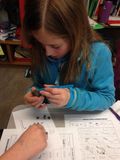
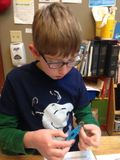
We learned about owl adaptations and how pellets are formed and then ("Finally!" as one student said) we got our pellets. As students discovered bones, they compared and sorted them using a bone identification chart. We looked at the anatomy of the different animals we were discovering – including the ball and socket joint we could re-construct with pelvis and leg bones of the rodents we found. Using our jewelers' loupes, we took a closer look at the cancellous bone structures inside the skull. Two students found mole skeletons and we were able to look at the huge difference in the forearms of moles compared to rodents. A favorite find was orange rodent teeth – made orange by the iron that strengthens one side of the tooth so that the back side wears down to an edge and a sharp, knife-like tooth is made. We also found rodent teeth that were over an inch long but slipped inside the bottom part of the jaw – and we spent a long moment contemplating how weird it would be if our teeth continued to grow indefinitely the way our hair does.
As we wrapped up our lab, students recorded how many different animal skulls and bones they found in their pellets. Today we compiled the class results and discovered that 89% of the meals our owls ate were mice, 4% shrew and 7% mole. We considered how scientists might use data like this about owl diets in an area. And finally, we shared questions that our work prompted and what we would want to find out next (a fair number of those questions focussed on just how pellets are made.)
All but one Heron would like you to know that they would be very pleased to receive owl pellets for their next birthday or holiday gift. (The link is provided in paragraph two). Have fun!







 The Rookery
Leave a comment