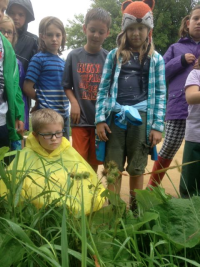
 Sometimes, you just have to take a deep breath and dive in. As I'd planned for Forest School this summer, I'd imagined our first crystalline day outside together — the blue sky would beckon, bird song would fill the air and a gentle breeze would stir our hair. Instead, we got Wednesday – wet, warm, mosquitoey. But the philosophy behind forest school is that by going out regularly, in all types of weather, students (well, humans) become more attuned to nature. On a rainy day, you see things you'd miss on a sunny day. So out we went.
We began by defining the expectations of outdoor learning. It's not recess. Students are expected to be able to come together for lessons and then work independently. My colleague Nancy piloted outdoor learning last May and had a lot of wonderful tips to get us going in the right direction.
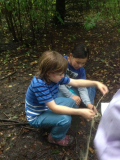
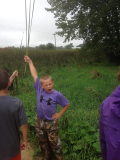
We explored the school grounds to establish our home base. We found the perfect spot (by enthusiastic consensus) and I taught the students square knots, clove hitches and taut line hitches as we put up our first ridge line shelter. We'll need a lot more practice with knots before they become automatic but I was excited to see the students working together to decipher the knot diagram I gave them for the taut line hitch.
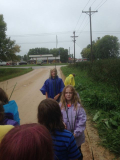
Then we headed down Denmark Avenue to harvest reeds in the wetland across from the convenience store. We stopped when we arrived just to listen and share what we noticed – cicadas, crickets, warbling bird calls, clicking noises, frogs, cars. We also shared things we wondered about and what we were reminded of. These three questions are key to the work of scientists (and readers and mathematicians): What do you notice? What does it make you wonder about? What connections can you make? I was amazed that after just thirty seconds of listening students had many wonders that we could have pursued with research projects: how many different animals are here? How do cicadas make their sounds? Would we hear the same sounds if it was sunny?
We also found a beautiful black and yellow garden spider on her orb (females are huge so we knew that's what we were seeing). 
We harvested cattail reeds and discussed the guidelines for harvesting plants in nature (never in a protected area and, if harvesting is allowed, only one plant for every ten we count (a great ratio lesson!)) The reeds are drying in our shelter so we can use them next week to make floating duck toys that were made historically by Ojibwe children.

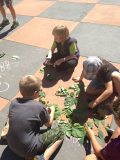
The next day we went out to collect leaves and sort them by type. The Herons learned about compound leaves, simple leaves, lobed leaves and needles. The students had great observations as we talked about leaves we had trouble categorizing. We'll use our skills next week as we work with dichotomous keys to identify the trees on Prairie Creek's property.
Back in the classroom, the Herons analyzed several different pictographs to determine how to most effectively display their survey results. By critically considering different representations, the students gain a much greater appreciation of what makes a "good" graph and what graphs are supposed to do. Whenever possible, we don't teach kids one way to do something — we have them consider approaches and then teach us the way that's best. They then completed pictographs and are now working on their fractional and percentage circle graphs.
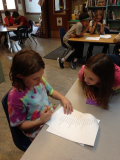
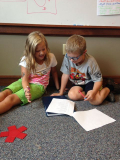
But wait…there's more. The Herons also worked to define what we believe about ourselves as a group. These guidelines will become our "rules" — but they go far beyond the typical "raise your hand" or "clean up after yourself." We began the work in pairs, writing 4-5 possible belief statements. We are now working on synthesizing and broadening our initial ideas. In the coming days, we'll have discussions that will enable us, eventually, to come to a consensus about what's important to this group of Herons.









 The Rookery
Leave a comment