It seems that about once a month, my "to write" list gets overwhelmingly long. I want to take the time to dig deeply in this blog and enable you to get a sense of the reasoning that goes behind our work and how the pieces fit together…but I also want you to know what's going on in a timely manner. So here are some short(ish) updates about our work.
I've asked each Heron to find a memorize a poem. It can be of any length, serious or silly. The purpose is two fold: we'll have twenty poems at the ready to fill in a moment between activities and all of the Herons will have some experience with memorization. We'll be sharing our memorization techniques – writing things out repeatedly, sub-vocalizing, read/cover/say/check, mnemonics, visualization. These are techniques that can be applied to memorizing lines for a show, math facts, or vocabulary in a new topic. If you are interested in learning a poem alongside your Heron, that would be great. I've linked the title to a book of possibilities and here's another that the Herons are using: Forget-Me-Nots.
Ancient Greece
 Students have had an introductory week of research. Initially, they had to choose which city-state they
  would be a part of and what gender they would portray. Then the fates decided on their role. Some are elites, some are slaves. We had an awful lot of people want to live in Sparta (perhaps because of the relative freedom that women had) so we enticed some to come to Athens which, if you were a free male, had a lot more options for how you spent your time. Students have been getting into the spirit of things, participating in Spartan P.E. activities and enhancing their endurance by going barefoot at recess.
Students spent the week researching their character – what type of schooling, home, food, daily life would he or she have? What would they look like? What would they do (if anything) for fun?. In the coming weeks, we'll be adding to that knowledge by looking at religion, government structures and economics. We'll also be traveling through Greek history through a series of newspapers. Here's an example: Download Eponymous_Hero_1. We read the newspapers together (with Gabe and me adding commentary and modeling character reactions from our characters' viewpoints) and then students write a reflection journal about the day's events. If time allows, they also write about their character's personal life. One thing students are already learning is that it can be hard to understand and see the personal impact of public events – at least at first.
 Gabe took on the role of Socrates (sans Hemlock) and led a discussion using the Socratic method on Thursday. Students really enjoyed exploring the question, "What is a chair?" One of the Herons exclaimed excitedly, "I can't wait to ask that question at the dinner table tonight!" The Herons also really enjoyed analyzing this picture.
If you have old white sheets you'd like to get rid of, please send them in. We've had a lot of requests for chitons!
Fractions
We have been having a great time exploring fractions in math. Our focus has been on naming fractions, creating equivalent fractions, and comparing fractions. Some groups have worked on combining fractions, too. Gabe, Cathy and I have all been using tasks that engage students in mathematical debate — "forcing" students to support their ideas and articulate their understanding. For example, students may be given this image and asked to find the fraction of the whole shaded:
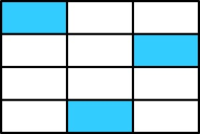
Then, they are told that another student has said that 1/4 is shaded. Is she correct? Why or why not? By pushing themselves to articulate their arguments, students expose to themselves (and to us) the parts of their understanding that are still shaky. I had one fraction number talk in which five different answers were given, none of which was the correct answer. During the explanations of how we got answers, however, all of the students came to a better understanding of what they were seeing and mis-seeing (and they all got to the right answer, too.) In the image below, we had a robust conversation about how to figure out a precise answer. Students approached the problem by breaking the "T" into five smaller squares and then taking portions from there… 
Forest School
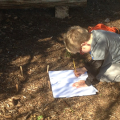
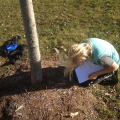
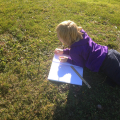
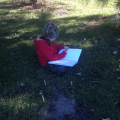
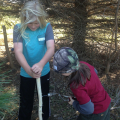
Wednesday may be our last warm forest school day for a while (I originally typed "beautiful" but revised it.) We took full advantage and started to build a fence for our winter encampment. We also chose a square foot to map carefully — we left our boundaries up, we'll see if we can find the same square in the spring. 
At one point during our work, students suggested setting up a Christmas tree. Others objected, pointing out that Christmas was a religious holiday. The Herons quickly began thinking about creating their own holiday. I ended the day by reading them Byrd Baylor's I'm In Charge of the Celebrations, a beautiful book whose narrator carefully observes nature and declares celebrations based on what she sees (a rabbit looking at a triple rainbow or a green parrot in the clouds). We'll be watching carefully for days that we want to remember.
Writing Circles
A little over a week ago, students looked back through the rough drafts they had created during our writing circles. Based on their peers' reactions and revision ideas, they chose one piece to bring forward through the publishing process.
First, everyone revised by adding description, clarifying confusing parts and removing redundancies. Then we typed up the second draft in Google Drive and printed it, warts and all. Students went through the piece four times, each time editing for a different aspect of mechanics. (Here is a mini-lesson detailing what we did.)
After making the changes in their typed piece, students send the piece to me for a teacher edit. I love editing using Google Drive. I can easily standardize punctuation and spelling. More importantly, I am able to make notes about edits, explaining why I've made certain changes. I don't explain every change, just the ones that are next on the student's learning continuum.
Students then publish the piece. We hope to compile everything into a literary magazine for you to enjoy over the Thanksgiving holiday. Monday and Tuesday will be busy days for us to make our goal.








 The Rookery
Leave a comment