 The end of the school year always moves so quickly — I often return to the blog and realize how much has happened that I didn't have the chance to share with you. With all three of my kids off to the same camp (summer Village) and them not needing volunteers to teach Peep University classes just yet, I've found myself with the chance to share some of the Herons' goings-on in the last month of school. I'll start with Forest School.
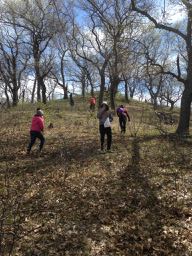
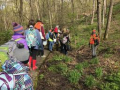
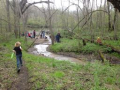
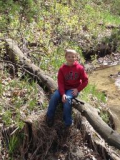
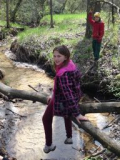
On the day before May Day and the start of Village, we went to the Cannon River Wilderness Area for a final exploration hurrah. Josie, Cassie, Tom, Nancy, Cale and Remy (our student teacher for Fall '18) came with us and we had a grand time exploring. The forest was bursting with spring ephemeral wildflowers and we hiked down to the Cannon River, then back up through the forest to a tiny patch of oak savannah which had just had a controlled burn the weekend before. We ran up to the top of a giant hill (which the students were all able to identify on our topographical maps) then used the maps to find the remains of a hermit's farmstead. That led us to a huge burbling spring and we followed the creek back to our trail finding another spring and a lot of old farm implements along the way.
Then we had lunch.
Julie Klassen and Tim Vick, members of the Friends of the Cannon River Wilderness Area, joined us for the afternoon 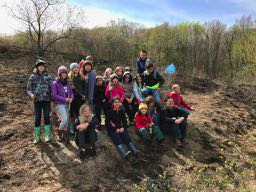 and taught us about the geology and history of the park (and about their roles as conservators.) Armed with new knowledge about the springs, some of us went back to look at them again with Tim and he asked casually if we'd been to the sandstone cliffs yet. SANDSTONE CLIFFS!?! I'd had no idea there were sandstone cliffs so, of course, we headed to them even though our time at the park was drawing to a close (we got back to the bus just in time.)
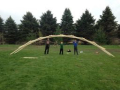
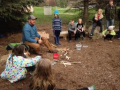
Our afternoon was filled with constructing a Da Vinci bridge (thanks Stephen!) and starting fires with a bow drill (thanks Joe!) as well as campfire cooking, whittling, lashing and many, many paracord bracelets. We ate together, sang together, played Skittles and then called it a night. When I went into the school building around 6:30 in the morning, I found many of the Herons reading and playing quiet games in the classroom. Some were even working on their city projects. Talk about awesome kids! We ate delicious pancakes (thanks Cathy and Josie) drizzled with our precious Heron-made maple syrup then went home with many stories to tell.
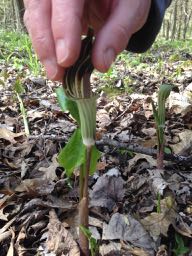 In so many ways, this culmination was a perfect microcosm of our year of forest school. There were many, many discoveries — some that I anticipated and others that were a complete surprise to everyone. We had to leave Cannon River Wilderness Area far too early — the students could have built and explored for hours more. Forest school had a different rhythm than the rest of our school days — students were often so deeply invested in their work that they would sustain an activity for an hour (longer if they could.) I found as the year progressed that our ability to "see" improved. Drawing a square foot of land took about ten minutes when we first tried it in October; by the end of the year, it took thirty-five. As we moved through the woods on our culmination, that same attention to the natural world was evident. We are simply able to see more.
Our afternoon, full of a mix of new and familiar activities, reflected our year of woodscraft work. Some students were hungry for something new every week, others sought the deep satisfaction of familiar, mastered skills. I struggled with this dichotomy during the year. Was it O.K. for some kids to whittle every chance they got? Did I need to push them into new learning? Were they wasting their time? Or were they honing their skills? I've come to think that, in education in general today, we're in a rush to teach a skill and call it done. Learning, though, often requires repeated work with a concept. Next year I'll work to provide a balance between presenting new learning and deepening learning by helping students better understand the trajectory of a skill.
Forest school was a great adventure for all of the Herons, myself included. As a teacher, I learned so much as the year progressed — both about teaching and learning outdoors but also about the students. I don't think it's a coincidence that many, many of the memories the Herons shared on our final day of school came from our work in Forest School. Progressive education holds that memorable, deep learning must have an authentic purpose. Students learn because they feel a compelling need. Being outdoors, working and wondering together, provided some of the most real learning I have been a part of.








 The Rookery
Leave a comment