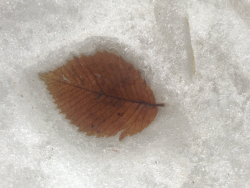
 We had a great conversation this afternoon about a phenomena that Simon observed while out on a hike. He saw that there were places where a leaf had sunk into the snow in a perfectly leaf shaped hole. I took the Herons out to take a look at this and then we had a great conversation about what might have caused this to happen.
- "The leaf is like a coat. It insulates the snow, keeping it the same temperature as when the snow fell. The snow stays warmer than the surrounding snow so it melts faster."
- "Maybe the leaf has energy from the tree. Maybe it melts the snow as it decays and releases the energy."
- "I noticed that the leaves were a darker color than the snow. Darker colors like paper or clothes heat up more." Another student added to that thought, "the darker things absorb more heat from the sun."
- "Maybe the snow was mushy when the leaf fell on it and the weight of the leaf pushed it down."
There was also some conversation about this phenomenon with dog and cow scat. The students felt that it may be something different going on because of the heat and weight of the scat…but, on the other hand, maybe the leaf wasn't as heavy or as warm but still had weight and heat energy.
Needless to say, I was glad that I hadn't just thought, "Oh, they'll know this!" We then read an article that explained more about the states of matter and phase change. It had a few oversimplifications but was helpful to give students some more information to weave into their explanations. With this little boost, they began to make connections to phenomena they had observed earlier in the theme such as when they were melting ice on the hot metal of fire ring, "Oh! The heat energy from the fire ring was entering the solid ice and turning it into liquid water and then vapor water!" Tomorrow, we'll read about how heat is transferred in matter.
Of course, after reading the article, we ended up with a lot more questions:
- How does gravity affect liquids?
- Is it possible to go from gas to solid?
- What is dark matter?
- Is there anything without any heat energy?
Never a dull moment.


 The Rookery
Leave a comment