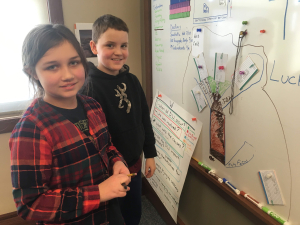
We are at a new stage in our personal projects. Initial research is wrapping up and students are organizing their notes to write. But how do you know when you have enough note cards? Students often want a number of note cards…but everyone takes notes differently and every topic is different. Instead, I share an analogy that seems to work for most students: the tree.
When I think I've gotten a good number of notes, I create a tree diagram – the trunk is my main topic and each branch is a sub-topic. I lay the note cards out for each branch. Is one a little puny? Do I need more details (leaves/twigs)? These branches are where I can focus some more intense research – perhaps by running a very specific internet search.
Do I have a branch that is a lot bigger than the others? Could I split that into two branches instead? Maybe I need to prune one of the branches that didn't go anywhere. Sometimes research is like that – a question you initially thought would be interesting proves to not have a lot of information. Another area is richer and begins to grow disproportionately.
How do I know when a branch has grown enough? I look back at my initial questions. Can I answer them now? Can I teach about them? We can't just answer the question, we have to have information to connect the dots for our readers. We have to have a lot of information around our initial questions . That's one of the big differences between personal projects in the younger years and fourth/fifth grade. Students have to broaden their research so that they can teach effectively.
When a student thinks that their research is ready, they take a branch and organize the information in the order it needs to be taught. Then they find a willing partner and they share all of the information orally, focussing on making sense to the listener. The act of "talking" research helps a student find the words to write. It also helps identify where a little more background information is needed. There should be connections among all the information in a paragraph and words do the connecting.
Students follow this writing process for each branch and then we are ready for revision. Very frequently, students have some information that is in the wrong paragraph. The idea of a single topic for each paragraph can be challenging. They've taken notes by color…so they often just want to write down all of the information from one color. But sometimes information was on the wrong colored note card; sometimes a topic shifted some so that the note cards no longer all belong together. The first step to revision is to identify the topic of a paragraph and make sure that every single piece of information belongs in that paragraph. If it doesn't, we just cut and paste it to where it should go now.
Having a good topic sentence can help students focus a paragraph effectively. Each sentence is checked against the topic sentence and if it doesn't fit, it gets moved. Connecting words and sentences help the ideas flow together. I encourage students to hear a "nature documentary" voice in their heads to help their words flow more naturally. Emulating is a great way to get the rhythm of a new type of writing.
We don't add our introduction or conclusion until all of our subtopics are finished. This way, we know what we need to prepare our reader for and how we might best wrap things up.



 The Rookery
Leave a comment