 As part of our microbes theme, we just finished All in a Drop, How Antony Van Leeuwenhoek Discovered an
  Invisible World. Big shout out thanks to Lori Alexander, the author, who sent us an advanced copy (the book won't be published until August.) of All in A Drop
Van Leeuwenhoek (van-lay-vin-hook) was the first person to see microbes (he called them "animamcules.") He was a cloth merchant whose hobby was making tiny lenses. Some of the lenses he made had 275-500 times magnification. He mounted the lenses on boards and then mounted specimens on to a tiny pin the exact distance from the lens to hold it in focus. These kinds of microscopes are called "single lens" because they rely on, well, a single lens (compared to the compound lens microscopes you might have used in school.) . The tinier the lens, the greater the multiplication.
Using one of his microscopes was difficult. In fact, many people reported they couldn't see anything at all when they looked through them and concluded that Van Leeuwenhoek was making everything up.
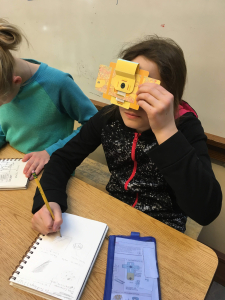
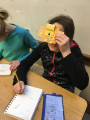
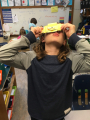
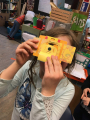
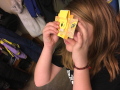
The Herons have made their own single lens microscopes — Foldscopes. These use the same technology as Leeuwenhoek but, instead of mounting the lens on a board, the inventors crafted magnets that hold the lens and specimen in place. We folded the scopes together a few weeks ago (thanks Katie and Lisa for lending a hand). It wasn't easy and after an hour, the Herons had scopes but hadn't used them.
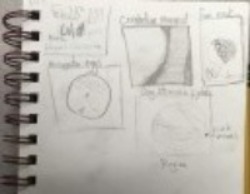
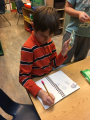
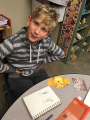
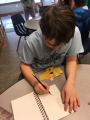
We got our chance last week – and it was hard. Really hard. At first all most of us saw was darkness. Then light. Then, perhaps, out of focus color. Then, suddenly, "WOAH! I SEE IT!" We were using prepared slides and students who hadn't seen anything would often ask to borrow the slide of someone who had seen something. But then, often, they couldn't see anything in that slide either.
It exactly paralleled the experience of Van Leeuwenhoek. In fact, he often wouldn't show people his most powerful microscopes because they would dismiss them as not working (when, in fact, they just hadn't practiced enough.)
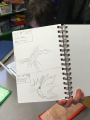
By the end of an hour, all of the Herons had managed to magnify a slide through their Foldscope. We still have more practice to do before we'll be ready to try to see any live microbes. After all, the things we've been able to focus on so far aren't moving!
I was proud of the Herons for sticking with it. I was glad we had had the opportunity to read about Van Leeuwenhoek and know that we weren't alone in our struggles. I was also amazed that Van Leeuwenhoek kept looking – even when he didn't know anything was there. Wonder and awe, indeed.



 The Rookery
Leave a comment