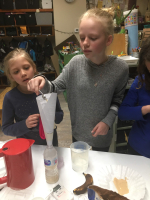
 Yesterday the Herons received a yeast pet (well, many billion yeast pets) and were given a chance to choose the temperature of their water as well as what food to give them. We observed what our yeast were doing and heated up their water or added different food — trial and error attempts to make our yeast happy and well fed. Chance and observation were the foundation of early science. Humans were able to use a lot of things they didn't totally understand because they were able to observe and experiment.
Today we talked about how, over time, those humans began to experiment by isolating variables so that causes could be identified more efficiently. Yesterday, we couldn't be sure if our yeast was happy because of its temperature or because of its food. Today, we honed our understanding by changing one thing at a time. Students set up experiments to test the ideal temperature (20g sugar in each bottle, 70, 110, and 140 degree water). We also tested three different foods – granulated sugar, banana, and flour.
It's crucial for students to know that science is a process in which our understanding is constantly being honed. We make observations that raise questions that we then can test. Sometimes, we have to develop technology to run better experiments and get a better understanding. The process never ends. There are always more questions; explanations are always becoming more focussed. Observation and pure wonder are still a crucial part of science — and the scientific process is one tool we have to develop our understanding.
Today's experiment indicated that yeast really like 110 degree water. 140 degrees seems to kill a lot (but not all) of the yeast. 80 degree water also works, just more slowly. Oh, and yeast really like banana.
I shared the chemical reaction (C6H12O6 → 2 C2H5OH + 2 CO) that the yeast's enzyme triggers and the Herons were excited to see how all of the atoms are accounted for. It will be years before they need to fully unpack what a chemical reaction is but today's lesson gave them a sneak peak at the wonder of our chemical building blocks.
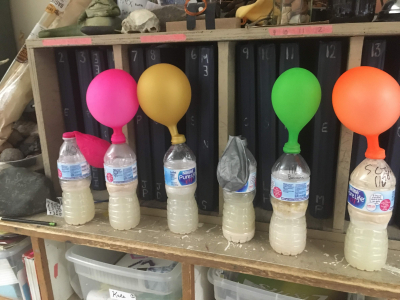
If you're not able to get outside because of a thunderstorm, this was a pretty great way to spend the morning.


 The Rookery
Leave a comment