 The Herons begin our morning with independent reading. Each child reads a just right book or article — one that is interesting with the right amount of challenge. Already in class, we've had several discussions about finding your learning zone (zone of proximal development for all of you Vygotsky fans). When something is too easy, we lose interest; when something is too hard we get frustrated or "bored" because we can't engage. A just right book is satisfying (and often I'll invite the students to read a "dessert book" for the last five minutes of independent reading – this is a book that is very comfortable or a partner book or a "looking" book. You and I might call it a "beach read." Honoring books that are not intellectually taxing but are enjoyable is important, we read for many different reasons.
We know that time spent reading is the single most important variable for reading growth. However, it's important that students continue to receive instruction in the work of a reader. Learning about craft, vocabulary, inference, figurative language, structure in both fiction and non-fiction are all part of the fourth and fifth grade curriculum. Students also continue to develop decoding skills – learning prefixes and suffixes as well as more complex and less common phonemes. We use multiple tools to reach those goals:
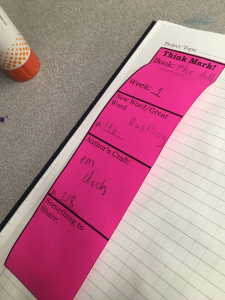
Think Marks – The "think mark" is a book mark that helps students concretize the diverse work of a reader. Every week, students note new vocabulary they come across and authors' craft they notice as they read. They teach a small group about what they have found during Think Mark share. In addition, students set a goal for the coming week and calculate the average number of pages they read per day. This last data point helps them self-assess whether a book is just right and how they are doing on their reading stamina. Students are expected to read for at least thirty minutes without a break but it does take practice to get there. We've already had a lesson on "staying in book world" and I've measured students' reading stamina in two different sessions.
Book Clubs - Once we've established our reading routine, I will introduce book clubs. Students read a "just right book" in a small group and discuss what they've read, developing arguments and supporting their ideas with evidence from the text. Students are also responsible for completing a role for that week – teaching the other students about vocabulary or summarizing the excerpt, for example. Book clubs develop students' ability to make inferences by demanding that they have reasons for their ideas about books and characters. I'm always looking for book club volunteers. Let me know if this is something you'd like to do.
Non-fiction articles - Most Wednesdays, we read a non-fiction article. We analyze the structure the author used to share information as well as the craft that was used to help us understand a new topic. Of course, we learn about the topic as well. This is one of my favorite ways to introduce content for theme or to get the Herons excited about something new. Cathy has inspired me to share daily news articles with the children as well.
Word Study – we develop students' spelling and decoding skills during word study. After a formative assessment, students receive instruction tailored to their needs. Some will learn about greek and latin roots, some will identify and generalize common spelling patterns and others will work in Orton Gillingham inspired groups to develop the connection between word sounds and spelling patterns.
Read Aloud – our shared reading experience is an important time for me to instruct children on craft, vocabulary, inference and characterization. It's also important for students to continue to have fluent reading models to emulate. I share my thinking as a reader, the moves I make to construct and revise my understanding.
Theme Reading – we also read articles related to our theme. This gives us a chance to get more experience with vocabulary and concepts. It also gives the Herons an authentic reason to check for comprehension since they will need the information they are gleaning from what they read for future theme activities.
Sometimes students enter fourth grade thinking that being a good reader is reading the biggest book. Through our work together, students deepen their understanding of what it is to be a reader. They develop the skills they need to tackle new, diverse texts and they also, hopefully, develop a love of the things they can learn and the places they can go when they get lost in "book world."


 The Rookery
Leave a comment