In these past few weeks, I've been struck by what the Herons bring into the classroom. They are fonts of interesting facts and fascinating connections and seem to have something to say about just about everything. With this in mind, the first kind of figurative language we reviewed in reading was the simile. Similes are how our brains often make sense of new information, relating it to something we already know. The class's penchant for connecting lends itself to thematic learning — with careful planning, each new experience can weave together with the preceding, creating a rich and full tapestry.
An example from this past week:

On Tuesday, Margit Zsolnay came to the class to share Hungarian naming practices. The students practiced sharing their names in the Hungarian manner, last name and then first name. They also learned about the name day traditions in Hungary and the list of officially approved names that Hungarian citizens must choose from for their children. Margit also shared how the principal at a school she worked at once declared that the students would call her "Ms. Z" because her last name was "too difficult to say." Many of the children had a similar experience with people mispronouncing or mispelling their names. We had a good discussion about how taking the time to learn to say someone's name was a way to show them respect. BUT…
Earlier in the week, we had been working in small groups to learn about Fort Snelling and Bdote. The historical society re-named the site "Fort Snelling at Bdote" using the Dakota word for the area. Bdote means "the land where water meets" and Fort Snelling was built there because a bluff overlooking two rivers is a great place to keep an eye on things. "At Bdote" was added by the historical society to broaden the sense of place and be more inclusive of the history that occurred at the site. However, this past spring, some law makers moved to reduce the historical society's funding by 85% if "Bdote" was not taken from the signage at the fort. The Herons also read an article outlining a similar controversy around Bde Maka Ska and Lake Calhoun.
One of the arguments that students cited from the articles for "leaving the names alone" was that "Bdote" and "Bde Maka Ska" were harder to say and harder to remember. Some of them shared honestly that they felt that way, too. None of them are native Dakota speakers so the english names are easier for them. But then Margit came in and shared her story. We got to hear first hand from someone who had encountered just that kind of resistance (and reflect on some of our own experiences.) Who gets to decide a person's name? Margit's boss or Margit? Who determines names for places? What criteria should they use?
(A quick aside, just because it was really cool: As part of this same conversation, the students read that the "Save Lake Calhoun" organization was upset that the DNR was rewriting history. The Herons began to poke at this immediately. They felt that it wasn't "re-writing" history if you are adding new things. Eventually they developed the idea that "our understanding of history changes as we learn new things" so sometimes you have to reconsider things you once thought.)
Laying the Groundwork for Future Connections…
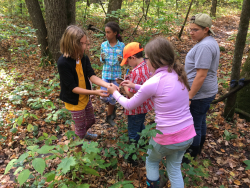
For the first half of our field trip, students ventured along the "Nettle Road" to trade with other groups. The prepared for the day by thinking about what their group would need to be successful travelers and each group created greetings, simple language like "yes" and "no" as well as cultural customs they would adhere to. Once on the the Nettle Road, some students focussed on raw materials – gathering clay or acorns to trade with others. Other groups manufactured things such as pots or jewelry to trade with others. They were only allowed to trade with the two groups nearest to them or with me at the central trading spot.
As we ventured around the park, students used the maps I provided but they also used names they created for landmarks. When they arrived at my settlement they had to figure out how to communicate with me — placing their hand on their head when they wished to speak…placing their hand on their stomach to show they were listening. Everyone had a different way to communicate – soon we were taking bits and pieces from everyone's systems. Two volunteers, Greg and Riley, shared new skills with the Herons – how to use nettle to make rope and how to fold origami stars respectively. They could take these skills back to their trading groups.
Much of this experience will be the foundation for our exploration of trade along the Silk Road in 800 CE. Students will travel along the route, interacting with other traders and learning about their language, trade goods, customs, geography, technology, and religion. The micro-experience on Friday will help them recognize patterns and more fully grasp the abstract concepts imbedded in our history role play such as the transfer of ideas among cultures and the economics of supply and demand. I hope (and with this group, it's pretty much assured) that I'll hear a lot of "that's like the Nettle Road…"
And then there's the unexpected
But a classroom would be contrived if I could predict exactly how each child would piece things together. What creates truly rich and authentic learning are the connections I haven't yet thought about, the commonalities that students find by themselves. That's when we are all learning the most.

 The Rookery
Leave a comment