At Forest School on Wednesday, I had the Herons look at an infographic from a recent issue of The Economist. I didn't give them much information about it – just the image below and the text from the inside of the cover that explained the creator had used color to show the deviation from the average temperature between 1970-2000. I encouraged them to puzzle out what they could, starting by making observations about what they noticed and what the numbers and colors might represent. Students are often surprised by how much they can glean from something that seems confusing at first and we'll explore a lot of infographics over the course of the year. Their reaction to this one, however, was strong: 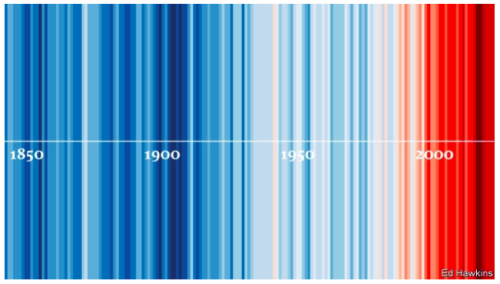 "What do you notice?" I asked. "The world's going to end!" one student volunteered, tongue-in-cheek…kind of. "Yeah, there's only, like, eleven years left," another chimed in. "Everything's going to explode!" I put the breaks on the conversation at that point.
The class had no trouble interpreting this particular graphic – but they did have trouble managing their feelings about it. "I think it's scary," one student ventured to lots of nods. I hadn't been teaching explicitly about climate yet this year so these reactions were from what students had been hearing in the news.
I was reminded of what Fred Rogers and shared when asked how to speak to children about catastrophes. "Look for the helpers…you will always find people who are helping." He expands upon the statement in the video clip below (here is the direct link if it's not working on your browser (https://www.youtube.com/embed/-LGHtc_D328?feature=oembed):
So I took his advice and we talked about what people are doing to help the climate crisis. Greta Thunberg is speaking up and getting people to care. Countless scientists are learning all they can about climate so we have the information we need to make decisions. Inventors are working on ways to power our lives, store energy and sequester carbon. Companies are committing to seeking out and creating new technology to help them become carbon neutral.
When we teach about climate at school, we work to make sure that we are teaching about the helpers. We respect children too much to cloister them — they will, after all, be the voters and the citizens who will need a very sophisticated understanding of their world to make some really hard decisions. But we also care about children and know that they are vulnerable and need help contextualizing information. They need a message of hope…we all do.
We try to make sure that learning about climate means learning about agency. Last year the Kestrels helped the school change to LED lightbulbs…this year the Robins are creating a podcast to share what they've learned about pollinators and bio-diversity (among other things.)
When you talk to your child about climate at home – and we hope that you are because children are definitely thinking about it, even if they aren't talking about it — frame the conversation by talking about choices you make in your home or things you consider when you vote. Resources like this one describing the world in 2050 and how we stopped climate change helped me feel more hopeful. There's a lot of work ahead – and there are a lot of people helping, too.

 The Rookery
Leave a comment