 Speaking of Faith(s)
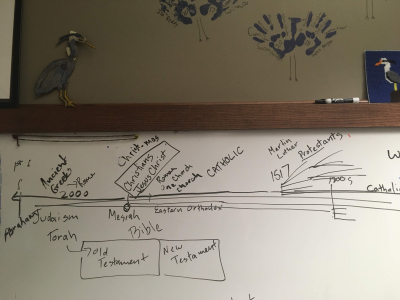
It started out at as a read aloud – an excerpt on Christianity from Mary Pope Osborne's One World, Many Religions. I wanted to share information about the early Christian church with the Herons and give them practice asking questions about beliefs. Before we got started, I briefly introduced the difference between learning about religious beliefs and participating in religion. We learn about religious beliefs in order to better understand the history, motivations and values of groups. When we learn about religion in school, we are not trying to prove that something is true or not true, we are just trying to understand the important elements of a faith. We are respectful when we discuss people of a faith and non-religious people. Because Christianity is the majority religion in the United States, it's especially important for students to learn how to interact with faith ideas respectfully. It can be easy when you encounter something different from what you have always known to think of it as "weird" but the Herons are developmentally ready to think more deeply about the religious and non-religious beliefs of others.
I've found that students often enjoy thinking about their own faith traditions in this way. Our conversation about Christianity quickly became an exploration of the way that the Christian church has changed over time. Constantinople was Eastern Orthodox in 800 CE, Europe recognized Rome as the center of the (at the time) single Christian church. Some students wanted to know how Lutherans and Baptists connected to this history so we talked briefly about Martin Luther. Many students shared that they were surprised by things they weren't sure about the history of their own faith traditions. "I know I believe something…I'm just not sure what," one shared. He determined that he would go home and get some more details from his parents.
Because the Christianity chapter mentioned Judaism, we read that section the next day. Students were surprised to see the connections between these two Abrahamic faiths and were interested in the fact that Judaism, too, has shifted and split over time into different groups. Looking at these two groups also gave us a chance to explore the calendar we use in the United States and the interweaving of the religious and secular throughout time. One Heron smacked his head in excitement, "That's why the book I read about Benjamin Franklin said that he had two different birthdays – they switched calendars during his lifetime!"
Along the Silk Road, we'll encounter cities in which Islam, Hinduism, and Buddhism are practiced as the majority faith. We will also realize that, in the relative peace in which the Silk Road flourished, most cities had people of many faiths. Indeed, in Antioch, where our caravans are currently, Judaism, Islam and Christianity have all been the majority faith in the past.
 A Visit to Antioch
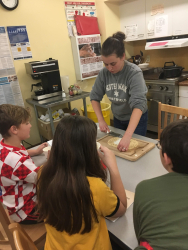
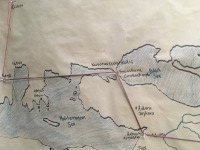
Today we were able to relax in Antioch for a bit. Most of us took a short boat ride on the Mediterranean to get here but two brave souls set out to find a quicker way to Seres. Sadly, their food ran out just as they were entering the Caucasus mountains. They were very lucky to be discovered by a mountain shepherd from a nearby town who shared his food and helped them find the way back to their caravan.
Antioch is full of wonders. Norias bring water from the river to the aqueducts that power the fountains for the whole city. The houses of some rich people even have running water. And the mosaics are exquisite.
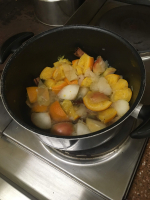
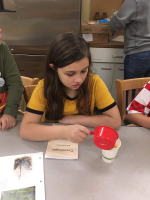
Many of the travelers rested in the tea house today and enjoyed some delicious apple tea, flat bread and cheese. While there, they chatted with the proprieter who had some very interesting information about the silk cocoons she had purchased at the market. (Thanks, Margit, for playing with us!)
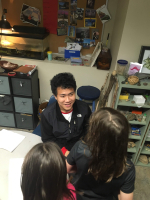
Alas, not all was peaceful. Some of the travelers found out that they could buy curses in the marketplace. Weary of some of their companions or perhaps trying to gain a competitive edge, some snuck denari out of their caravan's saddle bags in order to purchase a curse or two. Many Herons wanted to know if the curses worked. I reminded them that these were old Roman and Greek beliefs…Charlemagne would not approve. It will be a great jumping off point for how many superstitions and informal religious traditions can exist along side more formal, organized religious beliefs. (Many thanks to Khinny, our Carleton visitor, for driving a hard bargain in the market place.)
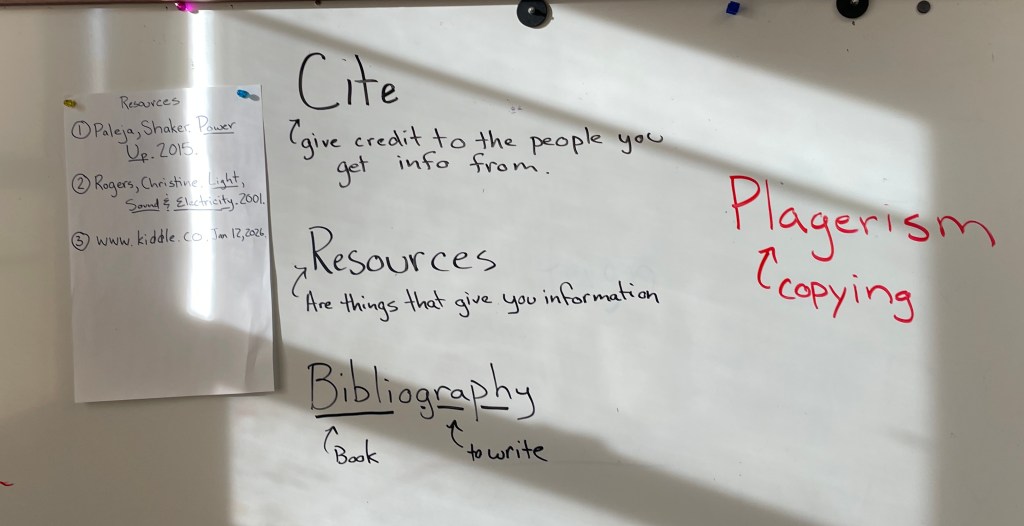
There will be a lot to talk about tomorrow when we work on our travelogues and reports for Charlemagne.
Wrapping Things Up
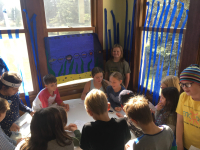
The Herons also got to attend the wonderful habitats culminating event of the Robins today. Each group made a podcast about their habitat complete with interesting facts, food chains and very podcastian banter. The groups also made awesome posters, dioramas, games and puzzles to help teach the school about habitats and how humans interact with them.
It's such a treat to be able to learn from our peers in such an engaging, real way. The Robins really knew their stuff and the work they did was inspiring. One of the Herons literally jumped up and down when she asked if we could do something similar at the end of our theme.

 The Rookery
Leave a comment