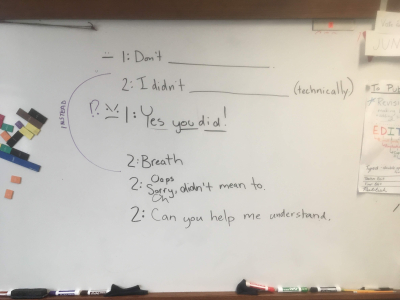
On Friday, I decided it was time to discuss the phenomenon of 4th and 5th grade lawyering*. Several conflicts had popped up, both among children and between children and adults that all had the same cause – individuals jumping into a defensive pose when asked to stop something because they weren't (technically) doing it.
Perhaps you've experienced this in your own home. It often goes something like this: "I asked you to put your dishes in the dishwasher!" "I did put my dishes in the dishwasher." "Your glass is still right here!" "You said dishes!" The Herons all smiled knowingly when I gave them a few examples. Almost all of them admitted that yes, they had done this at some point. (An aside – I think that it is a developmental stage as students gain more verbal skills and are able to understand nuanced differences in language. My husband was once a camp counselor and came across a child throwing water balloons when he had told him just an hour before not to throw water balloons. The child's response? "It's a Dr. Pepper balloon.")
When I asked the Herons about how people reacted to their "technical" excuse, they responded overwhelmingly, "NOT WELL."
This is where direct instruction on social situations is useful for everyone. We've known for years that some kids need to have social language and cues taught to them but, in fact, all kids benefit from some instruction. Even kids who are "fluent" in social language can gain empathy by hearing from their peers that this can be hard to figure out.
On the whiteboard we charted out why those kinds of responses often escalate conflict. In a nutshell, Person 1 is making a simple request that they don't see as a big deal – "That's my pencil," "Don't poke me," "Please don't talk," "I was sitting there." These simple requests are often just granted without any drama so, when Person 2 denies doing it (on a technicality) it is an unexpected behavior and, frankly, an infuriating one. Thus, Person 1 responds angrily.
So what to do? I charted out two possibilities. Both start with putting on the breaks and taking a breath before you say anything.
Then, option 1: Say, "Sorry, I didn't mean to." "What if you're not sorry?" one child asked. Other kids pointed out that their parents had asked them not to say sorry as often (for which they often apologized!) Indeed that word can be tricky. I pointed out that it's a powerful word to deflate angry situations. I often say it to make it clear there is no intention of harm. In the end we came up with a few alternatives like "Oops, I didn't mean to." and "Oh, I didn't mean to." We also agreed that some of us may need to say sorry less, but others need to say it more.
Option 2 you use if you genuinely don't think you did anything like what Person 1 has said. In that case, Person 2 should ask for more information or an explanation. We practiced tone for for this response. There's can be honesty or snarkiness in the words, "Can you explain to me exactly what you think has happened?"
Whew! What with processing and stories about "4/5 lawyering gone wrong" what started out as a brief check in took close to 20 minutes. The Herons didn't want to stop but we needed to get back to Baghdad (where our caravans in theme were stopping for the day). The consensus was that more lessons like this would be helpful. It was a great reminder that this pre-adolescent stage is a great time to talk about patterns that, in a few years, could be a lot harder to address.
* A quick shout out to lawyers – the attention to precise language is an invaluable skill that I greatly admire…it's just dangerous in the hands of a grumpy fourth grader.

 The Rookery
Leave a comment