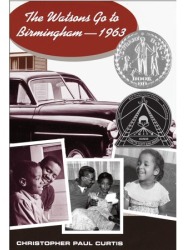
 The Herons are reading The Watsons Go to Birmingham, 1963 for our read aloud right now. The author, Christopher Paul Curtis, creates utterly believable characters who are part of a warm, loving family. Parts of the story are roll on the floor, crying funny. But other parts are hard…really hard.
The Watsons live in Flint, Michigan and are black. The story begins in Flint but, when big brother Byron crosses one line too many, the Watsons head south for a stay with Grandma Sands, a no-nonsense disciplinarian who promises a quieter summer of wholesome activity. The year is 1963 and Grandma lives in Birmingham.
Kenny, the ten year old narrator, has had to endure some racism in his life – teachers who hold him up as a "credit to his race" because of his reading ability; his sister Joeta is given a white angel doll. But, as the Watsons head south he encounters Jim Crow for the first time and his confusion and disbelief and fear mirror the reaction of many of the Herons.
It's a book that I have read before because I know it affords rich opportunities for the discussions we need to have about racism, poverty, colorism, segregation, racist systems and the legacy of slavery in America. There is never a comfortable time for these conversations – but it is crucially important that we make the time and space to talk — right now while our kids are still listening. I've heard too many stories of older white kids claiming after being caught Tweeting something racist, using a slur or sharing a meme, "I didn't realize it was offensive…" or "I didn't know…" or "it was a joke…" I want to make sure that our kids who are in the dominant culture will know better and I want to make sure that our kids of color know that school is a place where we are talking about the issues they have to think about every day.
So today, the Watsons stopped at a rest area at night in Appalachia and Byron peers into the dark woods and tells Kenny there might be "rednecks or crackers" out there who would hang them. I stopped to explain the terms "redneck" and "cracker" – Byron is using derogatory words for southern whites – words rooted in slavery ("cracking the whip") and Byron is worried about racists finding them and attacking them at the rest stop (sadly, a valid fear). We pivoted to a conversation about hurtful words that groups sometimes take back; they use the word themselves in order to neutralize the power of the people who were using the word against them. I explained that the n-word was one example. Sometimes white teens express confusion, "Why can't I use a word that I hear in music or I hear black kids using?" And the answer is, of course, it's not a white kid's word to use. Ever. Because they are not the ones who need to take something back. By stating that explicitly and clearly, and providing some context for the discussion, I hope that the lesson will stick and these white kids will be in a position to know how to stand up when they see racism and explain things to their peers.
I am not an expert. There are always parts of these conversations that I play over in my head and wish I'd found different words for. But these are conversations which must be had as we work to make this world better. As you continue the conversations at home, this reference from the New York Times might be useful. Thank you for your trust and the opportunity to grow and learn with your children.

 The Rookery
Leave a comment