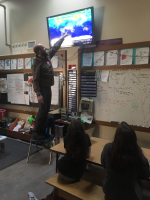
Tuesday's STEM day was a great chance for the Herons to learn about a broad swath of fields – the afternoon afforded us a chance to dive more deeply (quite literally) into a single field. Dan Hernandez came to teach the Herons about some new data we'll be collecting during forest school – the carbon respiration of soil microbes.
The seed for the project was planted last year when we were studying microbes. The Herons learned that almost everything on earth is teeming with microbes – including the soil. What looks like "dirt" is, in fact, an ecosystem. That's as far as we took it last spring…but this year we were ready for more.
An aside: one of my favorite parts of teaching in a mixed age classroom is the opportunity for the older students to teach our new Herons about what we learned the year before. Over the years, this organizational memory grows – some of what the older students teach is what they learned from the older students the year before. This layering is what can give a project like Village so much depth – there is a collected knowledge in the community.
OK, back to microbes. On Tuesday, Dan came in to teach us about what we would be measuring. First of all – we'd be
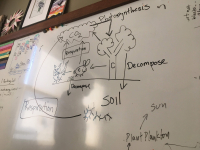
measuring carbon…but what is carbon? Last week, as part of our electricity theme, the Herons had learned about atoms, electrons, neutrons and protons. They knew that electrons moving was what we call "electricity" and we even got a chance to build atoms using electrons, neutrons and protons. We kept building until we created a carbon atom (this is still pretty abstract for the kids but they are beginning to understand that atoms are the smallest thing we can break "stuff" into and still have it be "stuff").
Once we had figured out what carbon was, we had to figure out what carbon had to do with microbes. Dan did a brilliant job of taking the Herons through the carbon cycle – first plants pull CO2 out of the air when they use photosynthesis to create sugars out of Carbon and water, then the carbon returns to the atmosphere in a variety of ways from us burning those sugars and exhaling to the energy being released through decomposition or the burning of fossilized plants. The Herons were charmed by the idea of Dan eating simple carbon to break down (a banana) versus more complex carbon like wood or coal.
But wait…there's more. When the Herons watched an animated map of the levels of CO2 throughout the year worldwide, they became alarmed. At certain points in the year, dark red clouds of CO2 (colorized data points in the animation) swirled over the globe. "That's bad!" several exclaimed. There is so much (justified) talk about climate change in our media that the students are often fearful but don't have a strong understanding of what's going on. It's like when I was little and would fall asleep with my head propped on my pillows so that I could hear the "nuclear sirens" with both ears. They know change is happening. They know it is bad. But the fear is vague. Many use language like "the world is going to explode" and "we're all going to die soon" when they talk about climate change. They are joking…kind of.
Dan beautifully and expertily helped the Herons place their understanding in a deeper, more accurate context. He pointed out that, in fact, this Carbon variation throughout the year has been part of the carbon cycle since there were deciduous plants. He acknowledged the students' understanding that CO2 levels contribute to climate change and that, yes, there was a lot more carbon in the atmosphere than there was a hundred years ago.
I interrupted and tried to help by pointing out that technology was one way humans adapt to new situations and that we've already developed technologies to help like wind and solar energy and that their generation will continue to innovate and create new ways to hold carbon. Dan was able to go even further: natural places like bogs and prairies and forests are already storing a lot of carbon. In fact, natural processes have already absorbed half of the extra carbon we have released with fossil fuels. Learning about the natural world, protecting it, and expanding it is a great way to have an impact on climate change. And, as Dan pointed out in his incredibly supportive, enthusiastic way, "You all are already doing that."
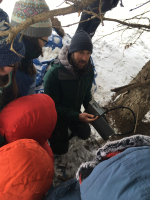
The next day Dan returned for Forest School and taught us how to use the CO2 monitor to measure the amount of carbon
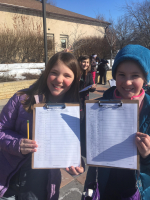
released by the microbes in a sample of soil. We've picked our site and will return to it every week as the weather warms to chart the activity of the microbes. Real science. It's very exciting.
I was struck at how quickly students go to a very dark place when it comes to climate change. You may be surprised to learn our data collection is not going to be connected to an explicit "climate change" theme. It feels like too much developmentally to burden them with that single focus. Ideally, there's not one "climate change" talk, but many small conversations along the way so that students build an understanding gradually and without fear.
Instead, the data will show us that as the soil warms, the microbes are more active. We may have a chance to look at decomposition rates, too. We will weave that into our understanding of the complex system we are a part of. Our impact on climate may be a part of the discussion but isn't the main thrust of our work.
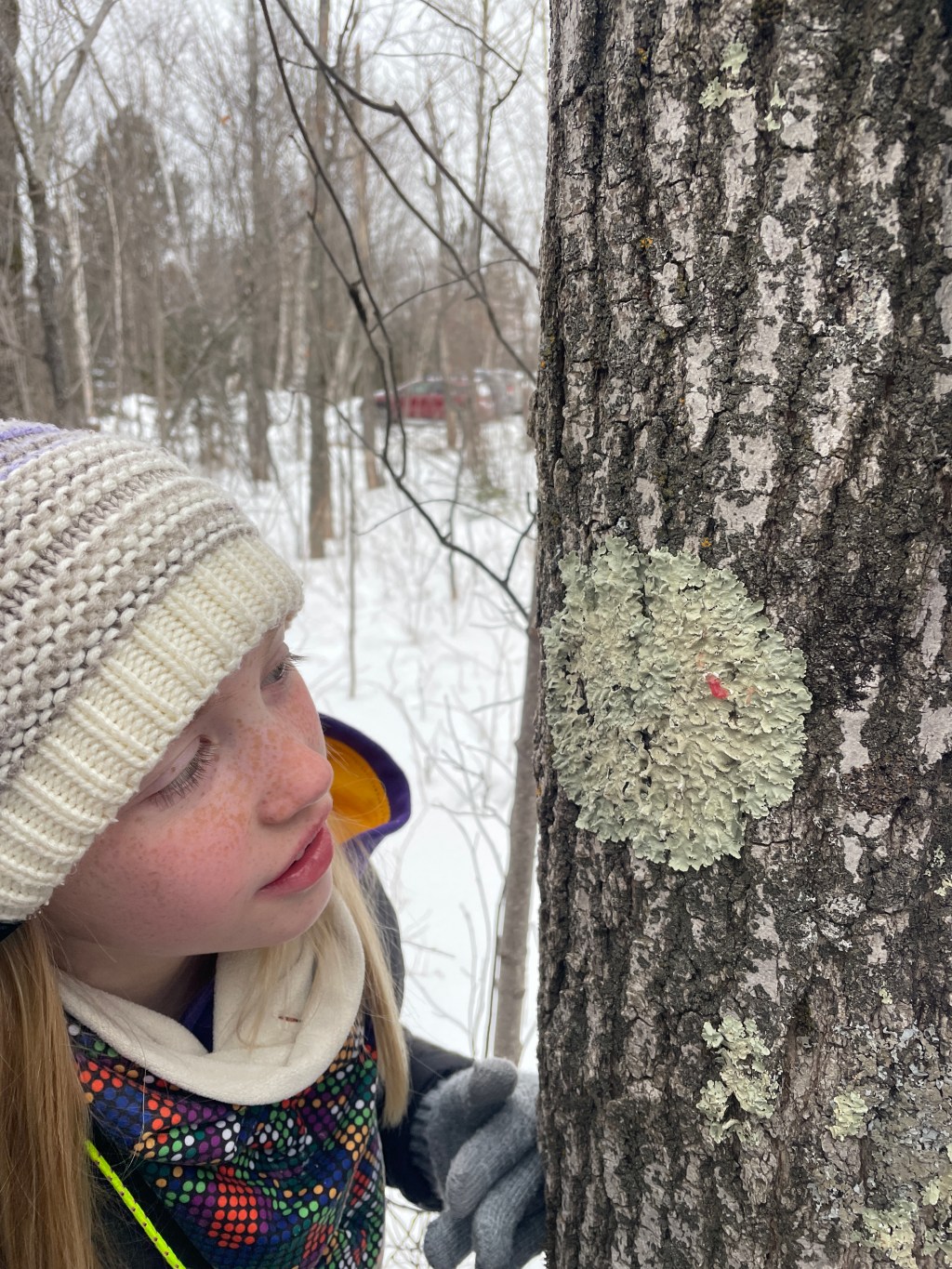
As an elementary environmental educator, I see my primary role is to help students develop a deep and visceral connection to their world. I want them to muck about and see how things work. I want them to watch a place change throughout a year. I want them to have a favorite plant, tree, mammal, microbe, rock, lichen, bug, fungus, bird, flower, seed, turtle. I want them to understand the processes that shape the world. I want them to be filled with wonder and awe. Right now is the time to lay the foundation and make the connections so that, as they get older and choose careers and choose how they live and choose how they vote, they will have a deep understanding of the natural world they live in and they will be able to affect the change we need.

 The Rookery
Leave a comment