
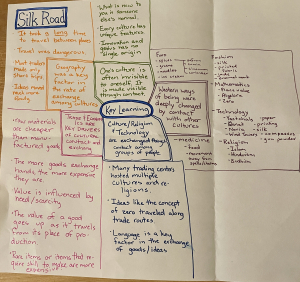
 This month, the teachers at Prairie Creek are focussing their work in professional development on Unearthing Joy by Gholdy Muhammad. Its central premise is for teachers to be culturally and historically responsive by ensuring that our instruction is rich in five different domains (or pursuits as she calls them). This past Wednesday, I was asked to analyze our current theme using the five pursuits as a framework. I thought you might be interested in some of that reflection:
Identity – how does the theme help students to "understand, validate, or celebrate their own identities or the identities of people who are different from them?"
We begin the theme learning about Europe (specifically the Holy Roman Empire) in 800 CE. We learn about daily life, the number system, the dominant religion, and the technology of the time. From there we travel to six more cities along the silk road and at each one we work in expert groups to learn about the trade goods, religion, medicine, language, craft, music and technology of the place we are visiting. One of Muhammad's key tenets is that students learn about the genius of their own ancestors and the genius of others' ancestors. Students learn about the roads and aquaducts of the Romans that are still used today. They learn how the people of Merv created a frozen treat in the middle of the scorching summer. They see huge buildings decorated with ornate tiles that tessellate perfectly. They learn about the invention of place value and zero as they pass through Baghdad and Kashgar. Finally, they learn about the invention of paper and moveable type when we visit X'ian. Every place we visit holds wonder and awe.
Skills – how does the theme help students "acquire skills of the content area and grade level?"
Each student is in an expert group with whom they do research and decide what key points they wish to share with their caravan group. They present to their caravan and take notes on what the other students are teaching about their expert area. Comprehending and summarizing non-fiction is key learning in fourth and fifth grade. There are many, many social studies standards that we learn, especially in economics, history and geography. Students also write letters sharing their learning. There are many "soft" skills woven into the curriculum as well. Students must successfully trade by interacting with a new person. They make decisions and compromise in their caravan groups. We also learn cooking skills and a variety of crafts.
Intellect – how does this theme help students "know something new about people, places, things, concepts or events?"
The theme's structure is built around curiosity and wonder. Students are members of Charlemagne's court and are traveling to the land of silk to learn the secret of silk making. Along the way, they are tasked with being careful observers noting down information that might be useful to them or valuable to Charlemagne. Students learn different things as they travel – some will work to understand the different religions we encounter, some will be fascinated by the number and letter systems of different cultures, some will be awed by the technology we encounter.
Criticality – how does the theme help students "make sense of systematic power, authority, and equity?" Does it "provide opportunities for students to understand multiple perspectives?"
The theme began with an exercise called "Hokias and Heelots" The students were each assigned to be a member of a made up culture. They interacted with each other based on the rules of their respective cultures and reflected on the experience. Even though the lesson only lasted an hour, students felt it helped them understand what it would feel like to be new to a place and unaccustomed to what was "normal" there. As we travel along the Silk Road, we talk about the customs of the place and what would be typical and unremarkable. I love David Foster Wallace's This is Water speech and while we don't read it as a class (it's a bit too salty for ten year olds) I do talk to them about the premise of cultural water and how difficult it is to see how your culture is not everyone's nor is it superior to others'. I think this awareness is the first step to unraveling bias and I hope this theme is memorable enough for students to recognize when they forget that they are in their own cultural water. That said, as I continue to enhance this theme, this is an area I can build on.
Joy – how is this theme advancing students' happiness and joy?
I think helping students find joy in their learning is a strength of progressive education. This theme lends itself to engagement. Role play is exciting and joyful (unless our caravan runs into bandits). Learning new crafts is exciting and joyful. Of course, making and eating new foods is exciting and joyful. And, the culmination when we get to teach everyone what we've learned will be joy-filled as well.
It was useful to think about this theme using the lenses provided in Muhammad's book. I first developed the theme by modifying a 7-12th grade curriculum created by Stanford University. I wanted to make it more playful and a bit more concrete for fourth and fifth graders. I also wanted to add more science and math. Many things that the Stanford curriculum assumed older students would know such as the basic tenets of various religions would need to be taught to our students. Every time I teach the theme I find opportunities to make it stronger and make more explicit the learning I want everyone to accomplish in the course of our work.
We'll be ready to teach you what we've learned in January (right now the plan is to be in X'ian next week – as long as we don't encounter too many sandstorms crossing the Taklamakan desert.) We can't wait to invite you to come along on our journey.


 The Rookery
Leave a comment