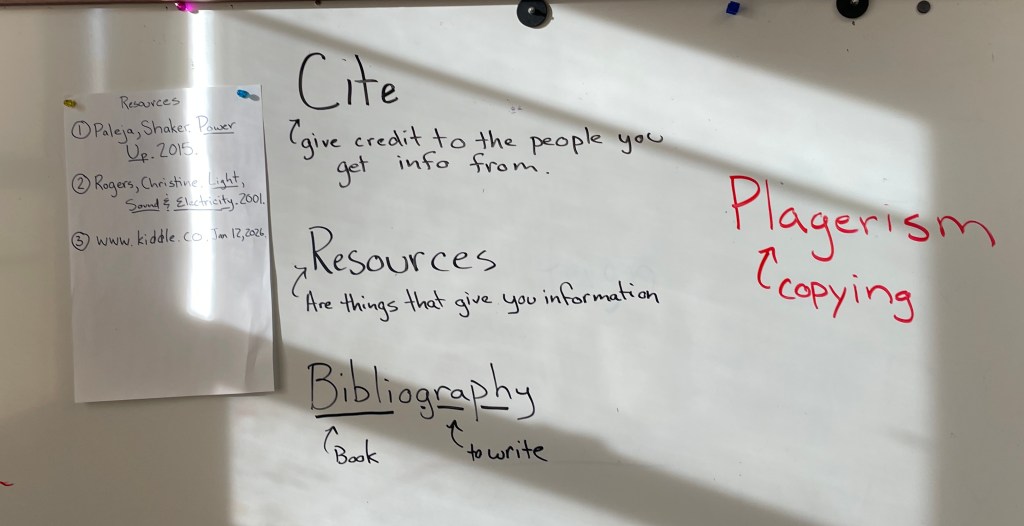
Today the Herons had a mini-lesson on how to cite sources for their projects. Before we go over the modified MLA format that we use to record all of the resources we use, it’s important for students to understand why we want to keep track of our sources. We emphasize to students that teachers (which is what they are) have a huge responsibility. They must teach accurate information and they must teach it so their students understand and are interested. Keeping track of where one gets information is a part of being a good teacher.
Verifying Information – Sometimes, fourth and fifth graders misunderstand what they read or hear. They can down notes that are not true. By keeping track of where information comes from, adults can help students verify information that seems a little off. Students are asked to number each source they use and put that number on every note card they take from that source. This (and the page number) enables us to go back and re-read together if necessary.
We also teach students that if they are looking at a website that doesn’t provide sources, it’s not a trusted website. Media literacy lessons are woven into our project work.
Giving Credit to the People Who Teach Us – We also teach the students about plagiarism – using others’ work and pretending it is your work. On the first day of my freshman year at college, the administration gathered us all together and told us that if we passed off others’ work as our own, we would be expelled. (You can bet we were careful with text citations after that!) I share this story with the Herons so they understand the responsibility they have as a writer and a teacher. We give credit to the people whose information we use. I am careful to explain to students that they are learning how to keep track of sources and give credit — we use a simplified system and we understand that they might make mistakes. No one will expel them if they forget to write down where a notecard came from! However, we want them to get used to giving credit so that it is automatic for them. The exact format and process isn’t as important as the feeling that citation is imperative. (A quick note – we just want students to keep a list of the resources they used and put those resources on their note cards. They do not need to do in-text citation – they will learn how to do that in future years.)
AI and Academic Honesty – While we were talking about being honest and giving credit to where ideas came from, it was an ideal time to talk about artificial intelligence. I explained that if a person uses AI, they need to explain how the tool was used. If you don’t share that you used AI, it’s the same as passing off something you didn’t do as though you did it. It’s dishonest and it’s wrong. I shared that every time I use AI, I include a disclosure that tells how I used the tool. If I don’t do that, I would be lying and I want people to trust the work I do and the information I share.
It may seem early to talk about AI. After all, we don’t allow fourth and fifth graders to do Internet searches independently, how would they get access to AI? I’ve learned over the years that if we can have these discussions with kids before they have access to the technology, they are much more receptive and much more likely to form good habits when they do have access. It is really, really hard to claw back kids’ access to technology or shift bad habits once they develop. If we can convince todays 4th and 5th graders that using AI without attribution is cheating and is wrong, they are much more likely to resist that temptation when they are in high school.
The project process is all about communication – asking questions, learning answers and effectively sharing those answers with others. Part of effective communication is being persuasive. To be persuasive, you must have good, trustworthy information. Learning how to cite sources is a big part of being trustworthy. It’s all a part of the process.


 The Rookery
Leave a comment