 My colleagues and I spend a lot of time thinking, reading and talking about math instruction. It's an incredibly complex topic and, unlike reading, there is no consensus in the expert community about how it should be taught. Part of the challenge is balancing computation and vocabulary with conceptual understanding and "thinking like a mathematician." Both elements are necessary to be successful in mathematics.
Unfortunately, it's much easier to design tools to assess children's vocabulary retention and computational skills than it is to understand how they think about math. The MCA once attempted to do both but cut out the open-ended questions because they were too expensive to grade. As we approached our unit on geometry, I felt myself being pulled toward a unit heavy on vocabulary. These are words they "need to know" I convinced myself (never mind that many of the terms are trivia — fun to know but only a Google search away if we, as adults, should forget them.) And, while I didn't want to really admit it, the primary reason I felt they needed to know was for the test.
But geometry, while it has a lot of specialized vocabulary, is also very much about how to prove a hypothesis in a logical way. Because it's hard to measure, it's not a part of what we're "supposed" to teach fourth and fifth graders. But we try to make room for it all the same — and sometimes, the students insist that room be made and that's what happened today.
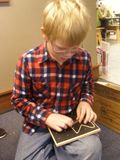
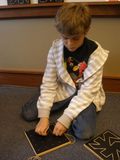
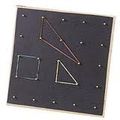 We were doing a pretty straight forward lesson with geoboards. A geoboard is a wooden board with 25 nails hammered into it in a square array. One uses rubber bands to to create shapes on the board. I called out different shape names "make a trapezoid" or different traits "a shape with 2 sets of parallel sides." Occasionally I would ask students to do something impossible "create a triangle with 2 right angles" and act indignant when students said they couldn't do it. They would have to convince me that it was impossible — the very beginnings of creating a mathematical proof.
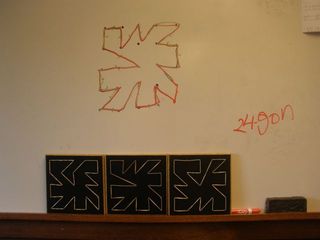
I ended the lesson (or rather, tried to end the lesson) with a challenge to make the n-gon with the greatest number of sides. 12, 15, 20, 22 sided figures were made in quick succession. I called everyone to the rug to do a quick wrap up but they continued to fiddle with the rubber bands as we talked. Then someone called out "23!!! A 23-gon!" Everyone was back at it, stretching their single rubber band to its limits. I drew the geoboard array up on the the whiteboard. "Do we know for sure that's the maximum or are you using trial and error." "Trial and error!" came the chorus back.
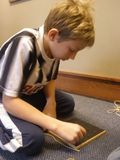
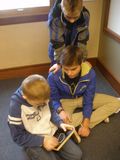
I knew that a lot of kids needed the next block of time to finish up map work so I ended the official math lesson but gave them the option of continuing with the geoboards if they wished. Soon Connor, our high school volunteer extraordinaire, had a group of eager geometers. They yipped when they made a 24-gon but, more importantly, they began to develop a vocabulary together. Here was an authentic use for geometry's terms. "I think we'll need a square type edge, like a castle…a square has more sides than a triangle." "But if you move that vertex, it makes a new segment here but combines segments there so its no different." They began to name the techniques they were using and the patterns that were developing.
They made the board smaller to see a relation between pegs and sides. Finally, they had a hypothesis: the number of pegs minus one will give you the number of sides. They were working on explaining why this might be when we really had to end the lesson to get to recess.
This was exciting and real math for them. It was a question their teachers had no answer to. They were discoverers. And it was a valuable reminder to me as an educator of the importance and power of wonder in mathematics. It's something worth fighting to keep in our instruction.


 The Rookery
Leave a reply to Dori Cancel reply