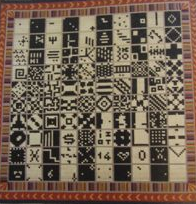
One of the Habits of Mind is to "Respond with Wonder and Awe." As I plan my math lessons, I keep this habit in the forefront of my mind. Even for elementary students who are still developing their foundational knowledge of how numbers work, math can be wonder-full and awe inspiring. Without wonder and awe, it becomes very difficult to answer the inevitable questions of "Why do we have to do this?" With wonder and awe, the utility of what we're learning is obvious – it amazes us, it excites us, we can use it to solve a puzzle or to make something beautiful.
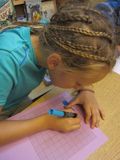
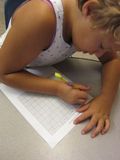
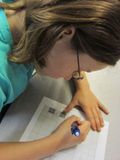
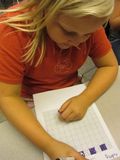
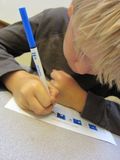
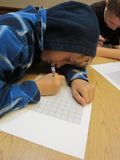
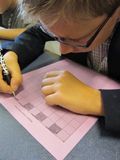
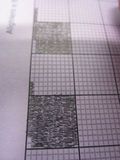
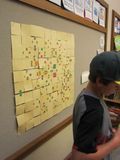
Our current unit is geometry. We began by looking at some of the work of Alighiero Boetti, an italian artist who played with ideas of reflection, symmetry and pattern. We each made a tile and then connected it to other tiles in the class by reflecting their designs onto adjoining tiles. We also are working on a series of pixel designs in which one adds a single pixel to each of 100 tiny 10×10 grids (
Download 100x100graphpaper). The first grid has a single colored dot, the last has 100. Of course, the negative space is the reciprocal of the positive – a great fraction exploration and entré into number bonds. (The link, by the way, is to a fun game that illustrates this concept.)
We talked about the greek root of the word geometry and read The Librarian Who Measured the Earth. The students were amazed to think about all that had to be figured out in order to judge the circumference of the earth. Erastothenes used angles (and camels!) in a very sophisticated way and it was a great way to introduce the concept of degrees and angles to the class.
We've been learning a lot of vocabulary but not just for its own sake. We've been using that vocabulary to talk about our work and solve problems together. Students learned how to use a drawing compass and were challenged to create concentric circles, tangent circles, intersecting circles and an inscribed hexagon. While they puzzled out these challenges, they were using their newly learned words — circumference, focus, radius, diameter — again and again.
We learned how to measure angles using a protractor but that knowledge really came in handy when students were trying to puzzle out how to make their computer create different shapes using the computer programming language "Logo" (try your hand here: Logo Interpreter). This command sheet may be useful:
Download Logo commands. As an aside, I love using computer programming to teach logic and engineering. Students are incredibly motivated to create using programming languages and they demand precise and flexible thinking.
This coming week we'll be exploring polygons and discovering the patterns that emerge when one splits polygons into triangles. Again, that sense of discovery is key to creating a meaningful relationship with mathematics and the thinking mathematicians do. If one simply receives information it is very hard to feel passionately about it. But if one discovers something, one owns it.


 The Rookery
Leave a comment