The post-it note on which I keep topics I want to mention in a blog has gotten embarrassingly full. Our days are very busy right now and there are so many moments in the day I think, "Oh! I want to share this!" The moments pile up quickly and the time needed to do them justice begins to lengthen. Tonight I'll chip away at the backlog a bit.
Phoning Home
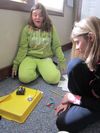
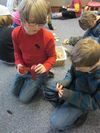
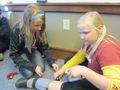
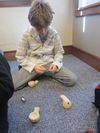
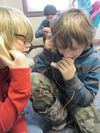
We had an unexpected block of time open up on Tuesday and I brought the Herons to our meeting area, gave them about 12 old phone handsets that had been sawn in half and challenged them to make them work. Using what they now know about series circuits (one continuous pathway for the electrons) the Herons were able to figure things out — they could talk into one end and a friend could hear it with the other end. Many students began to link up with other working phones to make party lines. More modern phones are like black boxes – they work by through the invisible electronic magic of circuit boards. The analog technology of these phones is easily understood and played with. You can make the magic happen.
STEM education
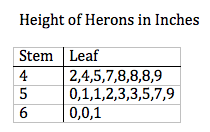 A stem and leaf plot is a specialized kind of data display with which you can compare quantities quickly like a bar graph but also look at individual data points. I am not sure I have ever seen one used outside of a math workbook but they are interesting, especially given our focus on puzzling things out. I knew that the students would initially be confused but that, because the content was something they understood (height in inches) they would be able to figure things out eventually.
I created a stem and leaf plot of Heron heights in inches and asked them to figure out the maximum height in our class, the minimum, the range, etc. At first, students jumped to conclusions. The minimum was "O" (because that was the smallest digit on the plot). I stopped them, was there someone in the class who was zero inches tall?! Where?! (We all laughed at the idea of an invisibly small classmate.) It is so important that students learn to think about numbers at all times in context. Divorced from context, numbers have little (if any) meaning. I told them the minimum height and asked them to re-examine the plot to find where that number could have come from. Pieces began to come together, "Oh, the stem is like feet and the leaves are like inches!" We considered that…one of the stems was 6. That would mean there were some students who were six feet tall. Hmmm…
Students soon realized the stems were the 10s place and once they had figured out how to read the graph, they were able to answer the data landmark questions in quick order. Those of you who notice such things will realize that I made up the heights on the chart above. The Herons decided to create a graph with their real heights. It turns out that all of the Herons were at least fifty inches tall!
 I could have just told them how to read a stem and leaf graph, of course. But then, I would have also had to teach them how to read every other kind of graph and, because new ways of displaying data are being created all the time, I would have had to anticipate the future, too. The Herons are instead learning how to use what they know to make sense of something new.
So Close
This is a very busy week of project work. Fifth graders are putting the finishing touches on a few things but their main job has been to mentor their fourth grader through some very new and very challenging learning.
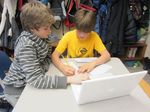 All of the fourth graders wrote their rough drafts independently (including an intro and an "outro" as they've decided to call the final paragraph). They then shared their work with a fifth grader and with me to get revision suggestions. Organizing ideas is a very challenging skill and many drafts got color coded and shuffeled around as students grouped similar information together.
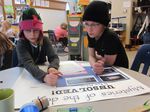 They all identified information that would be best taught through a visual. Many students drew a visual information element such as a map, a scale drawing, a visual glossary or a diagram. Students carefully crafted captions for each image they had chosen to use and they worked to share useful information in the caption. They also learned how to use color to frame images and captions and how to create a neat visual display that was easily legible.
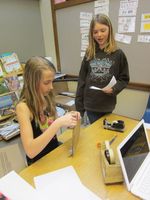 But wait, there's more! We learn about things in many different ways. Students had written their information for those who learn by reading, and they had created a visual to teach people that way. Now they had to distill their information into an oral presentation. They re-read each part of their papers and created "talking point" notecards to remind them of what they wanted to say. Students struggle at first because they want to write down every word they will say — which makes it very difficult to teach naturally. Instead, with practice and a lot of modeling, they learn to create prompts for just the pieces they really need to stay on track in their presentations.
Finally, students consider how to engage their audience with more hands on learning. What can you do that will help your audience really understand an element of your topic. One child is having students try their hands at pointillism for her project on impressionism. Another is dressing up audience members with the adaptations of various deep sea animals.
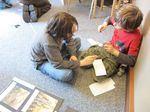 Whew! It's always very exciting when fourth grade parents come to see their children's presentation. For many, it can be a revelation. Fourth grade is really the cusp of being a big kid capable of big kid thinking and doing. The fifth graders have done a remarkable job supporting their mentees as they work through this very challenging project. (In fact, today there was an impromptu list on the board of fifth graders who were available to help anyone who needed it.) The fourth and fifth graders can't wait to teach you what they've learned.



Leave a Reply