A major theme in our four/five math instruction this year is flexibility. We know that students who are comfortable with math concepts are able to use them flexibly and creatively. They are able to play with numbers and use math to understand complex situations.
We've learned not to assume that students who are competent with an algorithm have a deep understanding of that algorithm or the math concepts it relies upon.
Our most recent math exploration focused on multiplication. I worked with my group on multi-digit multiplication. I began our exploration by leading students through a math strand. This is a series of equations designed to help students uncover a mathematical concept. It is a silent activity in which neither the students nor I talk while I am writing the equations and soliciting solutions (students put the answers on the board silently.) As the equations are written, students work independently to find patterns and make observations in their heads. They ask themselves what these equations have in common, try out hypotheses and wait for more examples to hone their ideas. This is hard work.* Here is a strand from later in our study.
3×4=12
3×8=24
6×8=48
12×8=96
12×4=48
6×4=24
6×2=12
After the strand is complete, I erase the star and ask students to share their observations and hypotheses about what is going on. In the example above (which was actually the 2nd or 3rd strand we worked on) one student noted that whenever one factor doubled the product doubled. I asked her (and the rest of the class) if she thought this was always true. She (and the rest of the class) weren't sure. Another student noted that for some of the examples, a factor was cut in half and the product was cut in half. Again, the students were hesitant to say that this always happened. So we explored some more examples and, in time, discovered that this did indeed always happen.
I always find myself surprised by students' hesitation to state whether something will always work. In some cases, they've been told it always works (such as shifting digits one place to the left when multiplying by 10) and they'll even do whole worksheets based on that but, when they're asked if it always works or why it works they stumble. They don't really know why which means they aren't ready to use the information flexibly or generalize it in any way. They don't yet trust what they've been told. They need to prove it to themselves.
And that was the work we set out to do. Besides the equation strands, we looked a lot at arrays. These are rectangles that represent a multiplication problem (3×4 would be represented by 3 rows of 4 squares or dots, for example). By breaking apart these arrays and putting them back together, students could prove to themselves that 6×8 was the same as 3×16 (an extension of the doubling of a factor was showing that if one factor doubled, but the other was split in half, the product was the same). They simply took the bottom 3 rows of 8 and shifted them to the side of the other 3 rows. Now they could see what they "knew" to be true.
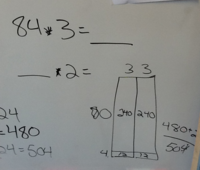 Next we expanded our work to bigger numbers, trying to estimate the number of beans in a jar. One jar held exactly 6 scoops. We counted several scoops and determined the average number of beans was 84. The students knew they could add 84 six times. But they knew this would take a while and they might make mistakes. The students also knew that they could multiply 84×6. Many had a paper and pencil algorithm they could use – but I challenged them to try to prove their answer was right. Below is one response. She explained that she could do 84×3 (which she split into 80×3=240 and 4×3=12). Then she would double that answer because it was 6 groups, not just 3 (her assurance came from our earlier work with the number strands.)
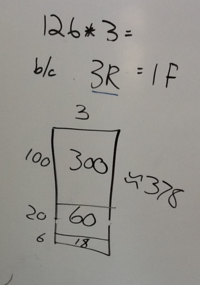 We shifted from big fava beans to smaller roman beans. One child estimated 3 roman beans fit in the space of 1 fava bean. He multiplied 126 (the number of fava beans in the jar) by 3 because each fava was worth 3 roman. To prove his multiplication, he broke down 126 into 100, 20, and 6 and multiplied each of them by 3. Again because of our work with arrays, he felt confident that this would work. (He now believes in the very important distributive property of multiplication – not because I told him that it works but because he's made it work himself.)
As an aside, when we compared this estimation and the estimation we did by counting scoops and roman beans in scoops. This one was off by a lot more. We looked at why and the students realized that if this estimate was a single bean off, the error happened over and over again (126 times, to be exact.) If we used the scoop method, the error happened just six times. To illustrate this key concept in estimation and data extrapolation – I drew a straight path along the whiteboard. We imagined that I set a robot off to follow that path but set it down just a little off. If the robot only traveled a little way, it wasn't far from where it was supposed to be. But if the robot kept going, it got farther and farther away from the original line. Our estimate was the same way.
Developing flexibility takes time and it takes repeated experiences. That's one reason we're using number talks a lot this year. It gives students a chance to try out different approaches and explore how they work. As math teachers, we once thought we should be moving students toward an algorithm as "the most efficient" way to approach a problem. I no longer feel that a standard algorithm is the endpoint of my computation instruction. It has a place, of course – algorithms help us keep track of large numbers in a systematic way. But deeper understanding of a concept is necessary to be able to really use math effectively.
* (footnote from the third paragraph) It is similar to the work students do in word study. There, I share a series of words and students look for patterns. They try to find a method to sort the words that includes all of the words in a meaningful way. I work with them to help them articulate the patterns they have discoverd. We talk explicitly about the power of discovering these patterns. That process is much more meaningful and lasting than if I provide a list of words and tell children the pattern they illustrate. Students want their spelling work to make spelling words easier when they are actually writing. It is only by creating a shift in their understanding that this long-term growth occurs — otherwise, students memorize words, regurgitate them on a test and forget them when they are in the throws of writing their next exciting story.



 The Rookery
Leave a comment