One of the questions we were asked when we presented our honors project process to a (very receptive) Northfield School Board was "How do you know what the children have learned?" (I'm paraphrasing but that was the gist.) We responded politely and shared our rubric with them — but the answer I most wanted to share was that they teach us and that's how we know what they've learned.
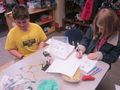
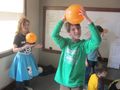
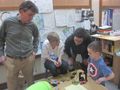
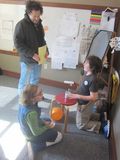
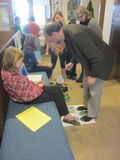
Culminating events provide a rich opportunity for us to assess in an authentic way what a child knows. During preparation, I note students' understanding and work to shift any misconceptions and extend students' knowledge. When students are teaching during the event I watch and listen to how they answer questions, how they explain their topic, how they interact with guests. Do they stick to their script or are they able to teach things around their original topic (a sign of deeper learning). Have they developed their own analogies? Did they copy something we did in class or create something new? Are their explanations accurate? Do they apply the vocabulary we learned together? Do they connect their information to the work of other students? How in-depth can they go? To me, teaching is one of the best ways to know what a child has learned. A child can't get lucky and pick the right answer. They can't "sort of" get it. And they feel a deep responsibility to do their best work – after all, people are depending on them for good information.
We are now in our final push on personal projects and honors projects. Students are preparing to teach either multiple groups of younger children (4th grade presentations) or a half hour lesson to peers (5th graders). The work of teaching is an authentic reason to learn. Students take the responsibility very seriously and it gives us as teachers a chance to see how well our students have learned to question, search, understand and explain. Ironically, honoring week is always juxtaposed by MCAs – from which we receive a number that is supposed to communicate what a child knows. Of course, it's what a child is demonstrating on a certain day in a certain, very limited way. Is that how I know how they've learned? I feel strongly that at Prairie Creek, we've found better ways to divine that. But until the state has the money to send folks out to visit ZAP! An Electrifying Experience, we'll have to be content with a number.
I'll write more next week about how we prepare for testing (and we do prepare students). But for now – thank you for coming to our culminating event, learning from our students and helping to me to see what they know.















 The Rookery
Leave a comment