
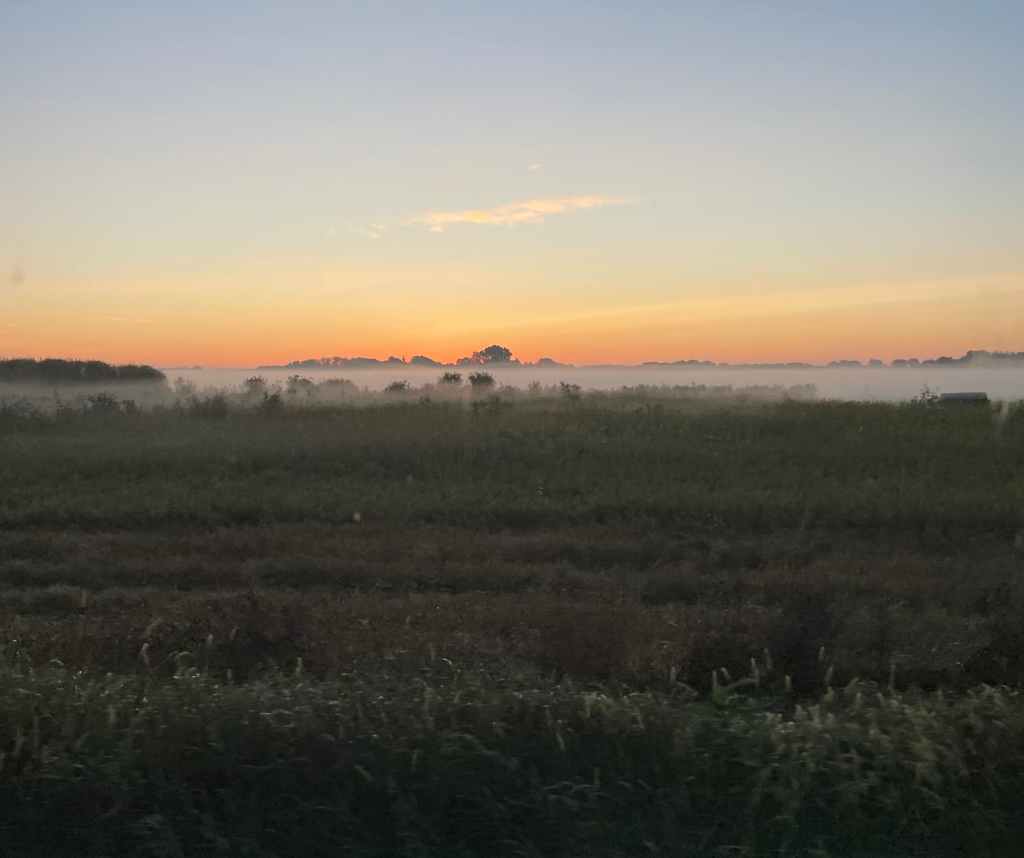
On Tuesday, we tracked the sun a day ahead of the autumnal equinox (which was cloudy). 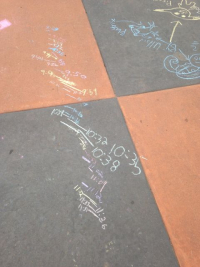 Having tangible experience with the sun's movement helps students begin to comprehend the reason for our seasonal changes. We'll get out again close to the winter solstice and again in the spring. It's only with repeated observations that students can begin to shift their conceptions of why we have the seasons. Many were astonished that we are actually slightly closer to the sun during our winter — it's the reduced number of hours of sun and the extreme angle of the sun that change our climate in the winter. When we track the sun in December, this will begin to make more sense. Look around your yard and see if there's a marker you can use to track the sun's travels through the season (of course, it's us traveling, not the sun…). For us, it's the fact that the sun is right in our eyes as we drive down second street for the first month of school. By December, the sun isn't even up yet.
Almost always when we're running an experiment like this, something unexpected happens. I love these moments when I don't have an answer and we can genuinely puzzle with the students (Cathy wrote a great reflection on those moments, recently.) We weren't able to record for the middle part of the day because of clouds, but we got some data at 1:50 when the clouds parted. The students had already predicted where "noon" would be based on the increments we had recorded in the morning. When we got our afternoon data, we decided to find the median point between that reading and the one an hour and fifty minutes before noon (or as close as we could figure; the rain had obscured our markings). The middle point, we figured, would show where noon was. But the median point was no where near our noon estimation! Why not?! We rechecked the math, it had been right. The students began to realize that "noon" on the clock might not be the middle point of the day in terms of the sun? Why not? Some of them knew that clocks had different times in different parts of the earth…and then they talked about time zones. It was a new concept for many and something we'll return to.
In math we are exploring decimals through the lens of the Olympics. Students are working in a rotation with Cathy and Gabe but they began with me, looking at archery. We reviewed what 12.2 cm (the diameter of the inner most ring on an archery target) was, breaking down the "wholes," the meaning of the decimal point and then the decimal place values. I work with students all year to read decimals using place value. Getting used to saying "twelve and two tenths" exposes the meaning of the numbers in a way that "twelve point two" hides the value. Having experience with decimals beyond our monetary system is also important for students to feel comfortable with decimals.

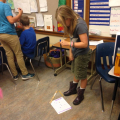
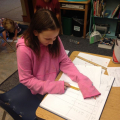
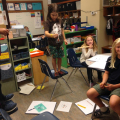


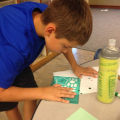
Students then dropped markers on an archery target, measuring how far from the center their "shot" landed. We recorded results in centimeters and millimeters, enabling many students to make discoveries about how multiplying (or dividing) a number by ten "moves" the decimal point. For many, measuring with such precision was new. We are also still working to tease out our two separate systems of measurement – don't get me started on feet and inches – it's a slippery understanding and students will often say something is "two inches and 4 millimeters."
Students also worked to find their maximum and minimum results. The range of numbers (maximum minus minimum) enabled us to tell who was very consistent and who had "wild" shots. Finally, we determined the mean (or average) of our individual data to see who was the best archer. Several students extended their work by measuring how long it took them to say the alphabet to the nearest hundredth of a second. This would be a great game to play at home, too, now that many of us have stop watches in our pockets. Have your child practice reading the time as "eight and twenty-four hundredths" instead of "eight point two four." The more practice they get the stronger their understanding and flexibility with parts of wholes.
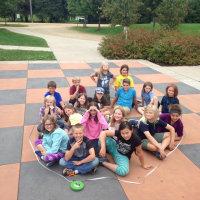
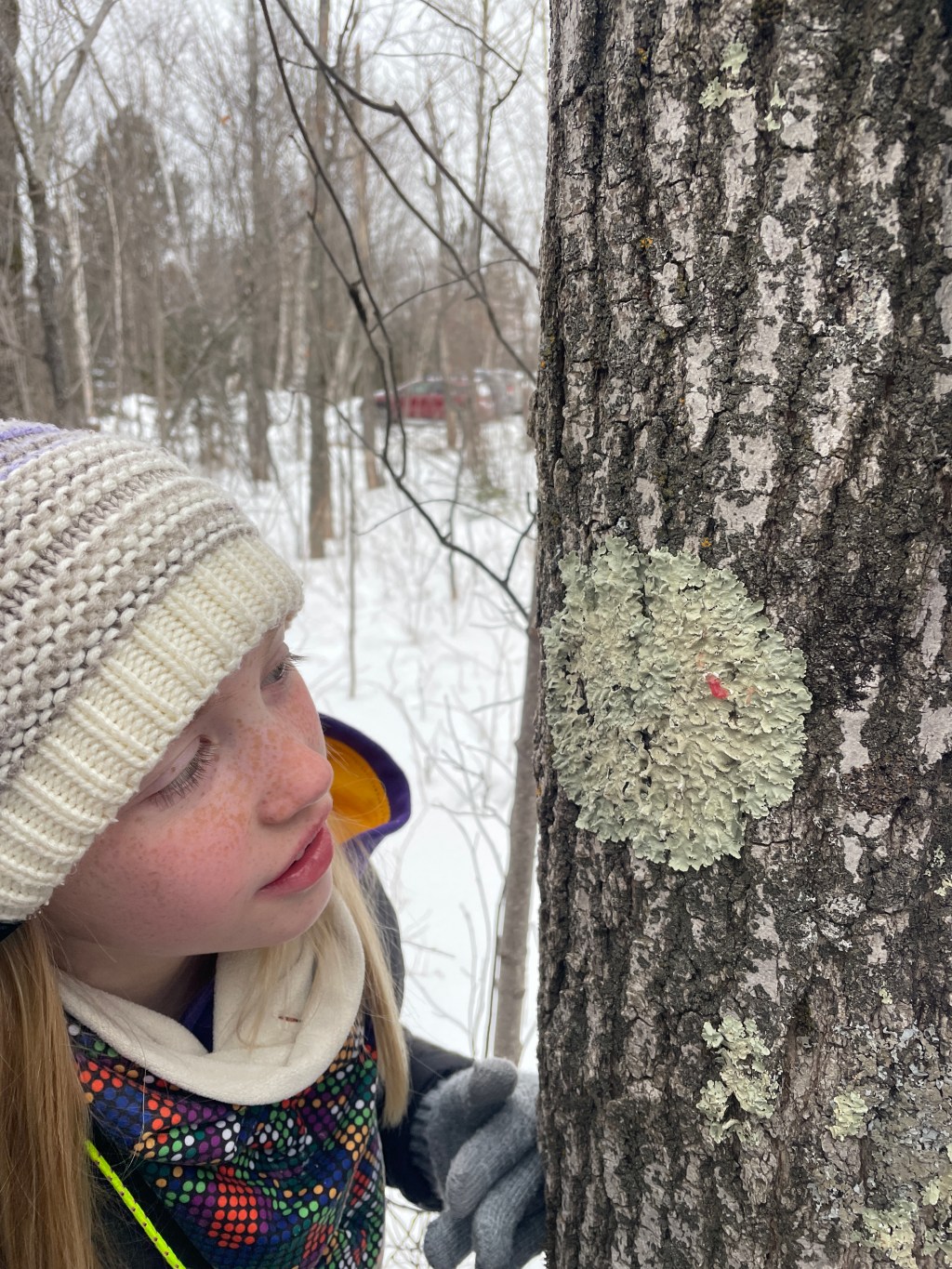
We also had the opportunity to take the Chickadees on a tree tour. Herons taught their Chickadees about tree identification and 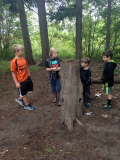 how to determine the age of a tree. Teaching is a great way for the Herons to solidify their understanding and see its value to others (the Chickadees were a very interested audience.) Simon came in to ask the Herons for advice on what to do about our ash trees. He had heard about the emerald ash borer from our land scape crew and was concerned. As a staff, we share what we are working on in theme frequently so that we can cross-pollinate and find genuine ways to use our learning.
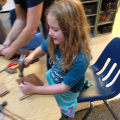
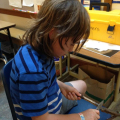
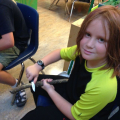
We ended the week on a high note – despite the cancelled field trip. Herons used our theme time to learn how to do some leather craft, work on journey sticks, and whittle. These are crafts they'll be able to return to in forest school and at our rescheduled Caron Park day. If your child has a pocket knife, this would be a good time to review your safety expectations. I teach students how to open and close a knife safely, how to hand a knife to others safely if it's not one you can close, how to find a safe whittling position (away from others with nothing in the way of the knife if it slips). I teach only to whittle away from the body. Whittling, even in this basic form, is very calming for students and many enjoy taking the bark off of stick after stick after stick.







Leave a Reply