As Remy and I reflected on the week, we were struck by just how busy the Herons have been. This is one of the sweet spots of the year when students thrill to see just how much they can accomplish:
Explorers
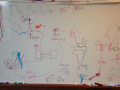
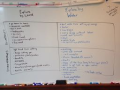
On Monday, we learned about Ibn Battuta, an explorer from Tangiers who traveled throughout the Middle East, Africa, and Asia. We've been working on note taking skills and the Herons really enjoyed creating visual notes (aka cartoon notes) of Battuta's life. The class used what they had learned about early exploration to create an impressive chart of the advantages and disadvantages of early and and sea exploration. We'll be using that chart to highlight how new technologies were created to overcome the challenges that early explorers faced.

On Wednesday, we took advantage of the sunny morning to create working sun dials and quadrants (which use Polaris to determine latitude). We also began work on a sun compass, a tool similar to what Vikings used to hold their latitude while traveling in the North Sea. To create our own, we marked the shadow of a nail as it crossed a board. This is the gnomon curve and by finding the point at which it passes closest to the nail, you can find true north.
Remy taught us about Zeng He and the invention of the compass. Students created their own water compasses by magnetizing needles. Even though all of the students had used compasses before, their was a collective gasp when the ones we made really worked! Suddenly, the Herons were full of questions about the nature of magnetism. Never content to just sit, the Herons began to improve upon their designs by changing variables to make the compass more robust for use on a ship. One child made one at home to see how long the magnetism in the needle would last (as of Friday it was still working!). We ended the week by learning about a traverse board and using dead reckoning to solve a hidden treasure puzzle. The students really loved this challenging activity and have asked to create their own traverse board puzzles.
Making Math

On Thursday and Friday we explored two real world math problems. While we were discovering solutions, we were also engaging in the work of "real" mathematicians and creating a list of what mathematicians "do". First, I shared a story about a house that my daughter Hazel and I had discovered on our way to work. There are four dog statues in the front lawn of the house which are regularly moved to new locations in the yard. How many different arrangements could be made (of course, that problem was really complex so we simplified it – the first in our list of mathematical habits of mind.) As students came up with solutions, they checked with each other, something else mathematicians do. Many But how to know if we'd gotten all of the solutions? Some students "just thought them up" and put down a tally mark. This was not very convincing. Others drew pictures – visualizing and model making is a crucial math skill – but we still didn't know if we had them all. Finally, some students had used a system to order their arrangements. This we found convincing since we could see that we had not missed any in the sequence. As we worked, students started to explore new problems and look for patterns – what if there were more spaces in the yard, what if there were more dogs (we had begun with three spaces and three dogs.) What if each statue were unique instead of interchangeable? Without realizing it, the students had stumbled upon an entire field of mathematics: permutations and combinatorics.
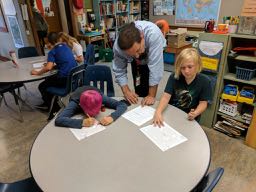
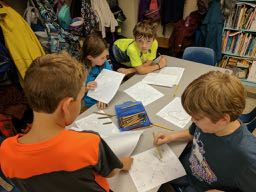
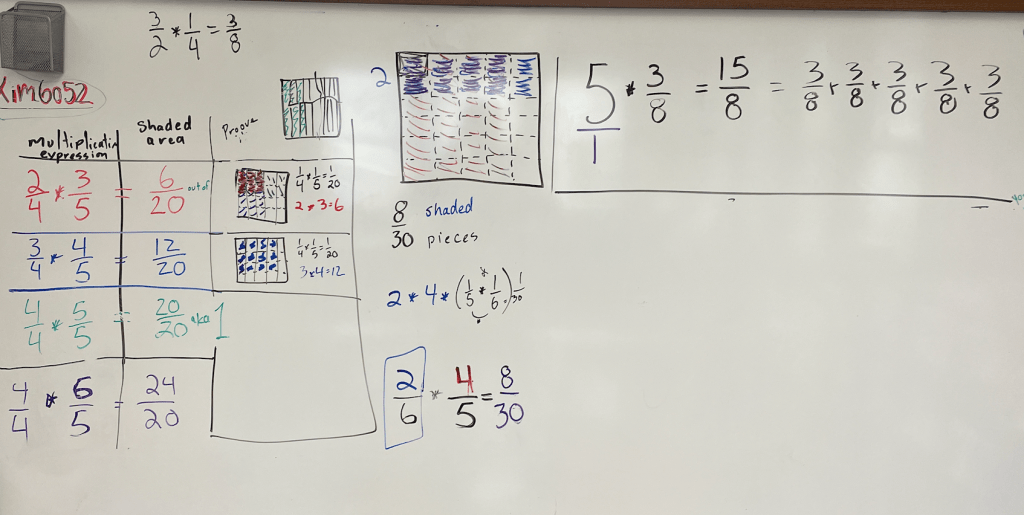
On Friday we tackled hailstone numbers. This is a sequence of numbers created by taking a starting number and dividing it by two if it is even and multiplying by three and adding one if it is odd. Then you do the same thing with the result to get the next number in the sequence. The numbers tend to get smaller then bigger, like hailstorms forming in a cloud. Unlike our first problem, this "problem" does not have a single solution. Instead, students were asked to look for patterns and make predications or conjectures about the sequences they were creating. Two children predicted that every number would terminate in 4,2,1. Others made the conjecture that odd numbers would have longer sequences than even numbers. Two children explored what happened with negative numbers. This is a real problem called the Collatz Problem and the main conjecture (the same one about 4,2,1 that the Herons uncovered) has not yet been proven! I am always a little nervous about introducing a problem like this. What if students just sit there and don't find anything to think about and explore? It's never happened. Kids are natural number explorers and as soon as they have an understanding of the situation, they're off. It's so exciting to see the room erupt in math energy. (Check out some of the board shots of the students' conjectures below.) Even after forty five minutes they wanted more – one student wanted help more clearly articulating her conjecture, one student spent part of meeting checking another's work, one took his blue book home to continue the pattern he was interested in and one child created a computer program to do the laborious math of creating a sequence. Very cool.
Writing Circles
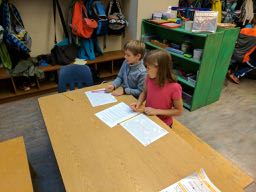
 We completed our first week of writing circles on Monday with our group share. In writing circles, students work in a small group to choose a topic. Then they each write about that topic independently. They come back together after two writing sessions to share what they wrote and receive revision ideas. We really like this writing class model because everyone is expected to share and everyone receives feedback every week. Students love writing for a real audience (their peers) and they are very motivated to have something ready for share day. The whole process begins again right away so students create a lot of text and learn that they don't have to stare at a blank page until the perfect idea comes. Indeed, if the topic is one you're not thrilled about, a new topic is right around the corner. When sharing feedback, students use what they've learned in mini-lessons to provide specific compliments and constructive revision ideas.
Serendipitous Science
So often at Prairie Creek, a current event or recess observation leads to learning that wasn't officially part of the syllabus but is still very worth while. Indeed, I think some of these conversations and lessons are the most authentic because they arise directly from students' curiosity. It is in these lessons we are really modeling the life long learning we want the students to embrace. Two such moments occurred this week. On Tuesday the Nobel prize was given to a group of physicists who had detected gravitational waves. These waves were predicted by Einstein a century ago but it's taken this long to develop the technology to sense them. It was an awesome opportunity to talk about the nature of science and its ever evolving explanations of the world we live in.
Working with the compasses also sparked a lot of questions about the nature of magnetism. Of course, there are a lot of questions about magnets that no one can answer…yet. We took about fifteen minutes to learn the best current understanding of how the earth's core creates a magnetic field as well as develop a better understanding of how our needles were magnetized by pulling iron atoms (each of which is a tiny magnet) into alignment. Not something that will be on the MCA but I guess we'll learn about it anyway.
Cursive?!
We also began instruction in cursive this week. The students really seemed to enjoy the very different rhythm of handwriting practice. I am teaching the letters by focusing on basic strokes and then using those strokes to form letters. So far, students have been exposed to the i and e strokes (which can create i, t, u, w, e, l, and b.) . We've been having fun coming up with words we can write with the letters we know. Fifth graders review the strokes and then concentrate on connecting the letters and developing fluency by copying out famous phrases and sayings (old school, I know.) Cursive gives some kids a fresh start on handwriting if they've developed bad manuscript habits. I think it's also important for them to have a solid signature and be able to read cursive even if they don't regularly write in it.






 The Rookery
Leave a reply to Linda Martin Cancel reply