There is a deep irony about writing this blog — the more excited I am about what is going on in the classroom, the more I want to share it thoughtfully and the more likely I am to put it off until I can "find the time to do it justice." So it's best I just begin.
Forest School
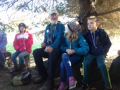
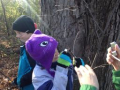
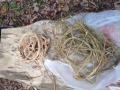
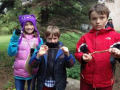
Greg Allen has volunteered to join us most Wednesdays (you are very welcome to join us, too!) and that has enabled us to try a new structure at Forest School. We split our time into thirds and the students rotate through in smaller groups. Three weeks ago Greg taught the Herons about nettles and they made nettle rope while sipping nettle tea. Remy taught the Herons about a two techniques to estimate the height of a tree (one of them was very funny looking!). Using ratios and measurement, the Herons determined which method was most accurate. I had the opportunity to take small groups on phenology walk abouts – and we made some great new discoveries.
Two weeks ago, Greg taught knots, Remy did a great poetry lesson (many students reported this was their favorite part) and I taught lashing and gave kids time to work on woodscraft.
As I reflected on last year's experience, I wanted to make sure to introduce more skills to students. This new structure enables everyone to learn new things every week as well as return to skills and develop them.
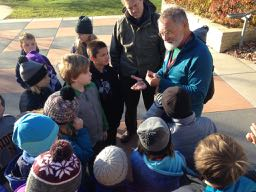
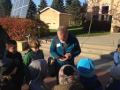
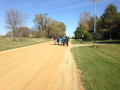
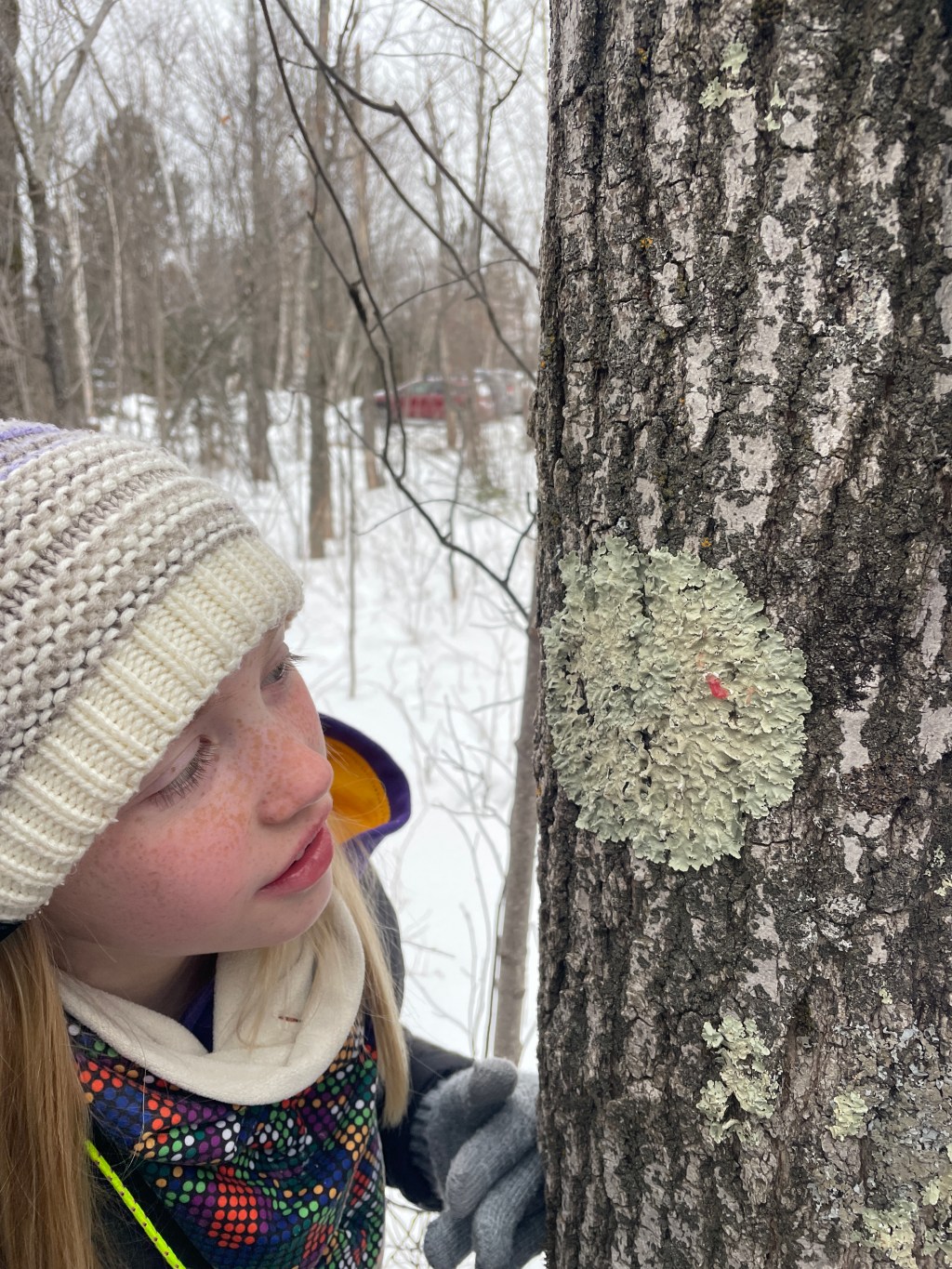
I also wanted to add more focused science work to our Forest School day. Phenology continues to be a rich area of learning for the Herons. This week we were thrilled to welcome John Latimer, the founder of the school phenology network. We went on a "Wander and Wonder" walk with John. We stopped every ten feet, discovering some new amazing thing. My favorite was a hatch of box elder bugs – some of them pure red. We visited a woodlot we have permission to study in just north of the school and by chance its owner, Mr. Dilly, was there clearing buckthorn. He joined our merry crew as we wandered back to Prairie Creek and showed John our encampment. It was a wonderful visit and the students loved meeting the man behind the voice they'd been hearing for over a month now. We were also joined by a reporter from the Northfield News who was interested in our work. Here is a copy of the article he wrote about his visit with us.
Explorers
To wrap up our work with the technology of navigation, the Herons learned about traverse boards and used the boards to create an orienteering challenge for their peers. The created a series of eight instructions (one for every half hour of the watch) that gave a compass direction and distance to travel in that direction. The instructions were then translated onto a traverse board to be read by another group in order to find a challenge. It was very, very difficult and the Herons soon realized that being off just a little bit at the beginning could result in bigger and bigger errors as you continued. Against all odds, every team found at least one of the treasures the other groups had hidden. We all agreed that, if we were to create another traverse board puzzle, four instructions would be plenty!
Just before MEA, the Herons learned about the European explorers Columbus, Cortez and Magellan. Students completed a menu of activities which could include making hard tack, comparing ship and navigation technologies, and designing a compass rose among others. Every two days, Remy and I presented a new pairing of explorer and the indigenous people with whom the Europeans interacted.
Whenever we work in social studies, we ask the students to consider whose story is being presented as "history." The conquered, enslaved and exploited rarely receive equal time in history books – and there certainly aren't continents named after them. For our explorer theme, we've asked the Herons to listen to the story of the explorers' trips from the perspective of the indigenous people and the Europeans. They wrote paired diary entries about an event and created summaries of each trip including the impact on indigenous populations.
This past week, Remy taught a series of lessons introducing the Herons to Lewis and Clark through analyzing and summarizing visual information. This gave the Herons a chance to practice summarizing – a key skill for fourth and fifth graders but one that is very difficult. (As you probably know if you've ever had your child recount a favorite movie.) . My favorite lesson was one in which the students received a letter to either Lewis or Clark, detailing why each was chosen as a leader for the journey. The letter was brown with age (and coffee) and students loved puzzling over the antiquated language. Many began a reply in the same voice.
In the next two weeks, we'll be following the trail of Lewis and Clark through a role playing adventure. The Herons are very excited.
Geometry
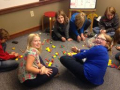
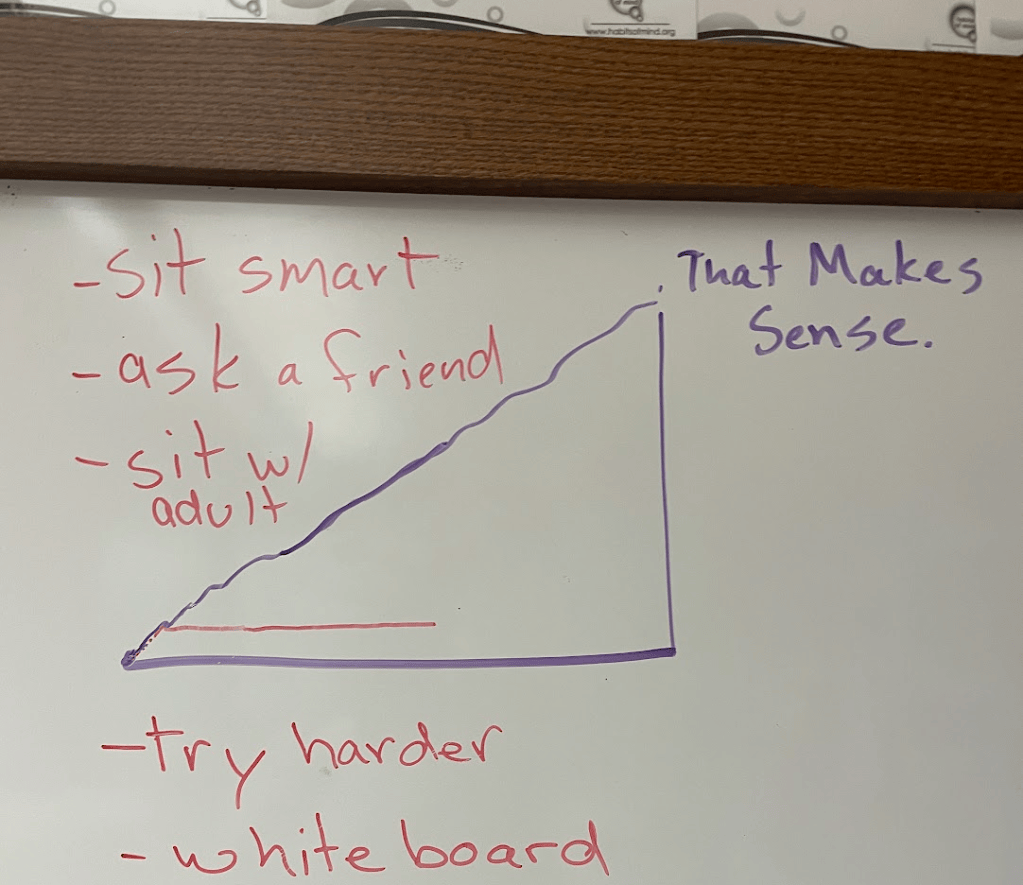
We've just wrapped up a geometry unit in math. Through a variety of puzzles and tasks, students explored angles and parallelograms. We were excited to hear students debating ideas with each other as they strove to develop definitions for parallelograms, rectangles, trapezoids and rhombuses. The curriculum we are using is designed to help students construct their understanding of math instead of being simply consuming information. For example, instead of simply being told what a rhombus is, students are given examples and counter examples that push them to look for similarities and differences. By pushing students to articulate what they are noticing, the learning is much deeper than if we just provide them the definition and move on.
Whenever we work in math we try to find "low threshold, high ceiling" tasks. This means that everyone can engage with the challenge and find a way to respond. The task is crafted to allow students to uncover more and more facets as they work. For example, students were given a rectangle that was divided down the middle diagonally. One angle's measurement was given and students were asked to figure out the missing angle. Students had to observe that the missing angle, combined with the given one had to equal 90 degrees. They then figured out how to find the missing number (which is algebraic thinking, using what you know to figure out what you don't know). Some students saw two identical triangles in the rectangle and found all of the missing angles by considering that the interior angles of a triangle equal 180 degrees. Another group of children were intrigued that the diagonal created the same set of angles when it intersected the top and bottom parallel lines. Did that always happen when you intersect a parallel line? One child posited that, if the rectangle was a square, then the diagonal would have made 45 degree angles…
We'll be exploring fractions in a similar way in the weeks ahead.
Writing Circles
We have wrapped up our first session of writing circles and students are working on revising and editing one of the pieces they drafted. Revision is a big skill in fourth and fifth grade. Students are able to consider their audience and are more willing to expand their writing in order to more completely communicate their ideas. Developmentally, younger students aren't able to understand that other folks might not see things exactly as they do.
We also practice editing. We read each piece four times, adding paragraphs then punctuation then capitalization and finally checking our spelling. It's laborious, especially if one's first draft was especially rough. But through that work, students learn the value of using grammar, spelling and punctuation conventions in their first drafts. They also take great pride in producing a finished product that is polished.












Leave a Reply