
Amidst the conference prep, the poetry, the personal projects and the snow days, our night theme has continued. We had a fascinating visit from Jay Demas who taught us about the eye and the body and brain's response to light. At one point, we covered up one of our eyes for about twenty minutes and then went into our kitchen. When the lights went out – it seemed pitch black. Until we lifted up the patch on our other eye which could see well by the exit sign lights – a kind of grainy vision that looked a lot like night vision goggles. It was really, really freaky to have one eye that was seeing and one that wasn't. Turns out, this is why pirates wore eye patches so they could flip it up and see below deck during a raid.
Jay's presentation focussed on how much the night world has changed since the first electric lights were invented in the early 1800s. Indeed, we looked at a light pollution map that showed there are very few places untouched by light pollution in the U.S. Artificial lights affect our sleep and the circadian rhythms of other animals, too. This might not seem like a huge deal but there is increasing evidence that sleep (both deep sleep and REM sleep) is chemically restorative to the brain. As the snow fell on Monday night and it seemed as bright as day outside my window, I realized that all of the light I was seeing was artificial – the clouds were blocking the moon and stars. The night should have been pitch black, even with the snow.
There was an unbelievable amount of information packed into our time with Jay – it will be interesting to see how the Herons incorporate it into their future theme work.
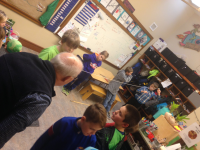
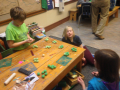
We had another guest speaker in a few days later – my father, Grant Martin. Dad was an earth science teacher before he retired and shared one of his favorite lessons in which students make 50 identically sized balls of play dough and then one additional ball. That extra ball represents the moon and the groups squish the other 50 balls together to create the earth (which is 50 times the volume of the moon). When we tried to guess how many moons would fit inside the earth – the Herons were wildly off. It was a great "aha" moment to get a sense of their relative sizes. We also tried to model how far away the moon was from the earth – again, many groups placed the moon about two to three feet away (in the scale of our model). In fact, the real distance (in our scale) was half way across the room! The next day we continued our moon exploration by combining all of our models and creating a new, bigger one – with a fist sized moon and a head sized earth and an orbital radius that went all the way down the concourse by the gym! We also experienced the cause of the moon's phases using a classic experiment. It was another of those "aha" moments when the Herons were able to break with misconceptions and begin to build a new understanding.
Watch for the super moon/blue moon/lunar eclipse this Wednesday between 6:50am moon set at about 7:30am! (If I read the map correctly.)





 The Rookery
Leave a comment