A trip to Menards always means mischief for me and this weekend was no exception. I found squarish plastics pails like Tidy Cat cat litter containers. I was reminded of some ice blocks I'd seen made for a winter celebration by Leondardo's Basement. I'd always meant to make some for school but getting a cat and buying it Tidy Cat litter seemed like a lot of work to make ice blocks. $2.50 per bucket however seemed reasonable…so I grabbed them.
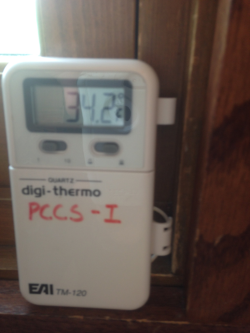
The Herons asked about the new green buckets right away and I shared my plan. Off they went to fill the buckets and we put them out on the roof. "How long would they take to freeze?" Depends on the water and air temperature. "What's the water temperature?" Let's use a temperature probe to find out.
The Herons have been very in to line plots recently and wanted to graph the temperature change throughout the day. It was a great chance to review how to match data tools to the data one is collecting. We decided on a line graph with time by the half hour on one axis and temperature on the other. We also decided to use two different colors to record water and air temp.

So far so good. By lunch the Herons were brimming with questions and I had one for them, too. Why was the water temperature dropping? Only a few Herons had ideas so we talked to partners to see if we could spark some more hypotheses. Many folks were pretty stuck so we did a thought experiment:
Imagine a kiddy pool on a cloudy, 80 degree summer day. What temperature is the water when you put it in? "Cold!" and by the end of the day? "Really warm." How warm? I had the Herons choose – more than 80 degrees, exactly 80 degrees or somewhere between the first temperature and 80 but never reaching 80. This time almost all of the Herons had an opinion – exactly 80 or almost 80. They talked again about where the heat was coming from and every pair came up with the idea that the air was giving some of its heat to the water but there was so much air that the temperature of the air didn't change.
I asked them to think about the water in our green buckets that were slowly getting colder. This time every hand went up. The water was losing heat to the air. We had a great conversation about the difference between that much water in a bucket vs. in a puddle…we're going to try a surface area experiment tomorrow at Forest School.
But, like all authentic learning, sometimes questions come up that I can't answer. This time, the kids noticed that the temperature was going down predictably until it "got stuck" at 38 degrees where it sat for an hour and a half. Why?
Why indeed? The school day ended, the Herons headed home but now I was stuck with a question I couldn't answer. If the temperature was 32 degrees then I could make sense of it. All of the water would need to freeze before the temperature of the ice would continue to fall…but 38? Gabe helpfully suggested that, maybe, the thermometer was faulty. Yes! It was reading exactly 6 degrees warmer…problem solved. BUT now we're not so sure it was a faulty thermometer. If it was faulty, then the temperature should have stayed constant until all of the liquid water around the thermometer was ice. HOWEVER, the temperature began to creep down again at 2:45 – along with the formation of needle like ice crystals. When I left school it was at 34 degrees and there were 4mm of ice across the surface. So the still liquid water would have been at 28 degrees if the thermometer was actually faulty…which I'm now not so sure about.
Several Google searches have given me the phrase "phase change" but, as Gabe reminded me – that would just make sense at 32 degrees…right? So we're still stuck (and I'm trying to resist heading back out to school to see what that temperature probe reads!)
One of the things I love most about teaching science is that there are always more questions than answers. That is the theme of Thursday's STEM day: Science is Powered by Questions. Now, if someone out there could answer our temperature question, I'd be much obliged!


 The Rookery
Leave a reply to Michelle Martin Cancel reply