One of the hardest things to capture about life in a progressive classroom – but one of its most crucial elements – is the sense that learning is everywhere and we have but to uncover it. The adventure of learning together instead of the teacher setting the course along a well trodden path is a vital part of progressive education. But being ready and open to those serendipitous opportunities to learn together isn't easy. As the teacher, I need to be comfortable with a large map of learning, not just a linear way through material. I also have to have the support of a school community that trusts that the learning we do every day will be rich and meaningful, even if I can't always predict exactly what we will discover in any given day.
I also have a responsibility to make sure I am teaching what students are expected to know…the vocabulary and concepts other teachers will be building upon. Finally, there is the challenging issue of "reproducibility" – shouldn't every class learn the same thing? How do we keep track of what students have learned? When I've talked a curriculum like Village to outside groups, folks often want a list of what we teach. And, while some of the content is predictable (we'll always learn about area, unit pricing, net profit, and direct democracy) other learning depends on the year. I can't guarantee that this group will get a deep understanding of how the over-production of cash can create inflation within an economy (but I can guarantee that any group that learns this in Village learns it very well.)
Here are three examples of "serendipitous" learning in the Herons from Wednesday this week:
Forest School
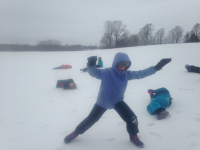
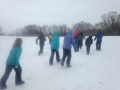
We took advantage of a gap in the test schedule to get outside on Wednesday for Forest School. We were on our way over to to look for mink tracks when one of the students jumped from a snow pile into what he thought would be fluffy snow. Instead, he left a fifth grade size dent in the very hard snow. Students noted how they were staying on top of the snow and that I was pushing in slightly more than they were. They knew this was because of my weight…but I gathered them up to explain a little bit more about force, mass and acceleration. The depth of the snow dent showed the force…which they could affect with acceleration.
I asked them to make up a hypothesis in their mind such as the difference between stomping vs. walking, running vs. walking, running up hill vs. down and test it out. Soon students were taking a much closer look at their foot prints. Stomping was creating flat, deep imprints vs. the deeper toe of walking prints (although some students had deeper heels…) . "The acceleration is coming from pushing our foot down hard when we stomp" . "When I go uphill, my toe is deeper because I lean forward so their's more weight in my toe." "When I go down hill, my heel is deeper because I'm leaning back." "I always have the same mass – as long as I keep my acceleration down, I don't make a dent"
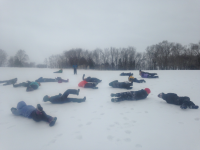
I didn't expect to have an impromptu physics lesson on the Dilly field but, short of a field trip to the nicely packed sand of a Florida beach, there couldn't have been a more perfect place to explore the concept. (And, yes, we did see those mink tracks — for the first time since the creek froze!)
Starbucks and Implicit Bias
The next example wasn't quite as spontaneous but depended upon a connection to current events – an opportunity one always has to be alert to. As a school, we look for authentic ways to bring conversations about race and bias into our classroom. Sometimes we do this through a theme or read aloud. Often, we can bring some of the outside world in to examine.
I shared the basics of the recent event in a Philadelphia Starbucks in which two black men were asked to leave unless they bought something. They explained they were waiting for a friend and refused to leave. The manager called the police. The two men were arrested for trespassing. The charges were later dropped and the president of Starbucks flew to Philadelphia to talk to the men and other leaders in the community. He has decided to close 8,000 Starbucks stores for a day in May for anti-bias training.
The Herons were incredibly thoughtful about what had happened and the outcome. Many shared stories of bias they weren't subject to – parents who had been given a warning instead of a ticket, jay walking that had gone un-noticed. Most had been in a coffee shop without buying anything. They also had a lot to say about anti-bias training. Several mentioned that we all have biased thoughts sometimes but that we have to be aware of them. They agreed that the folks who worked at that Starbucks probably went to school before things like that were taught.
A "Little" Village Lesson
Gabe, Cathy and I each do a short introductory lesson before Village so that everyone has a little more grounding in the game. Cathy explains how the bank and finances work. I explain how the government and store work. Gabe explains the wood shop, wood ordering and house building.
I set aside forty-five minutes to talk to the Herons about the Village government. I explained the U.S. system of three branches of representative democracy with federal, state and local levels. I then showed the the Village system – which just has a federal government and a town government and delineated the powers of each level. So far so good.
But as we started to discuss the direct democracy that we begin Village with, things began to get more interesting. Students wanted to know about our flag. Was there a Village flag? If so, would we have a pledge of allegiance? They wanted to know why we didnt' say the pledge every day and I explained that the school felt that kids shouldn't pledge something until they could understand what they were promising. So then they wanted to know just what the pledge of allegiance did mean. We got to "to the Republic" and then they wanted to know about Republics.
I explained that and representative democracies, and parliaments, and monarchies and dictatorships and oligarchies and theocracies. They stopped me there. Wouldn't we need a Village religion for a theocracy? Could the U.S. have a theocracy?
Then we talked about the establishment clause of the Constitution (we had talked about the Constitution earlier). Our constitution guaranteed that the government would not establish a religion which was why anyone can go to a public school and not have to worry about praying in a religion that was not theirs.
No day in Village goes by without something like this playing out. The events of the day ignite questions about history and civics that are hard to predict but utterly vital. It's so much fun to teach and I hope you can come in and experience it as a volunteer.
So…there you have it. Three short vignettes from a single day that demonstrate why it can be so hard to capture what has happened (or what will happen) in a progressive classroom. You have to have the experience to see the opportunities but you also have to have the structures (like Forest School or Village) to enable you to take advantage of the opportunities. It's why I love teaching – and it's also one of the hardest things to teach a new teacher how to do.



 The Rookery
Leave a comment